Buying surgical masks in bulk sounds simple — until you land on a supplier page listing “Level 1,” “Level 2,” and “Level 3” with a wall of numbers next to each one. Fluid resistance, bacterial filtration efficiency, differential pressure — it can feel like you need an engineering degree just to place an order.
Here’s the good news: once you understand what ASTM F2100 actually measures, choosing the right mask level becomes a lot easier. This guide breaks down the standard in plain language, so whether you’re stocking a hospital, a dental clinic, or an outpatient facility, you’ll know exactly what you’re buying and why it matters.
By the end, you’ll understand what each level protects against, how the tests actually work, common buying mistakes, and how to match mask levels to real clinical settings.
What Is ASTM F2100?
ASTM F2100 is the U.S. performance standard that defines how medical face masks are tested and classified. It’s formally known as the Standard Specification for Performance of Materials Used in Medical Face Masks, and it’s the benchmark the FDA relies on when clearing surgical masks as Class II medical devices in the United States.
Rather than judging a mask by how it looks or feels, ASTM F2100 grades masks using lab tests across several performance categories, then assigns each mask a level from 1 to 3 based on the results.
Why This Standard Matters for Buyers
If you’re purchasing masks for a healthcare setting, ASTM F2100 compliance is more than a desirable feature—it’s often a regulatory and patient safety requirement. Here’s why it matters:
- Patient and staff safety: Masks tested to the ASTM F2100 standard have demonstrated performance for critical factors such as filtration efficiency, fluid resistance, and breathability. This provides greater confidence that the product performs as advertised, rather than relying solely on marketing claims.
- Regulatory compliance: Healthcare facilities are often required to use PPE that meets recognized standards and may be audited to verify compliance. Selecting ASTM F2100-compliant masks can help support these requirements.
- Cost efficiency: Understanding the different ASTM protection levels enables organizations to choose the appropriate mask for each clinical setting. This helps avoid overspending on higher-level protection where it isn’t needed while ensuring adequate protection in higher-risk environments.
- Supplier accountability: Manufacturers that claim ASTM F2100 compliance should be able to provide supporting test reports and documentation. Verifying this documentation helps ensure product quality and authenticity.
The 3 ASTM F2100 Levels Explained
Level 1 — Low Barrier Protection
Level 1 masks are designed for environments where there is minimal risk of fluid or spray exposure. Often referred to as procedure masks, they are the most commonly used masks in general clinical and outpatient settings.
Typical uses:
- Routine outpatient visits
- Dental cleanings
- General exam rooms
- Low-risk patient interactions
Level 2 — Moderate Barrier Protection
Level 2 masks provide increased fluid resistance and filtration performance, making them suitable for environments with a moderate risk of fluid exposure, including light to moderate splashes or sprays.
Typical uses:
- Minor procedures
- Moderate-risk clinical tasks
- General surgery support in lower-risk scenarios
Level 3 — High Barrier Protection
Level 3 masks provide the highest level of barrier protection defined by ASTM F2100. They are intended for procedures with a high risk of fluid exposure, such as heavy splashes, sprays, or prolonged surgical procedures. These masks are tested for resistance to synthetic blood at higher pressures to help verify performance under demanding conditions.
Typical uses:
- Operating rooms
- Trauma and orthopedic procedures
- Procedures involving heavy spray or splatter
- Other high-fluid exposure clinical environments
Quick Comparison Table
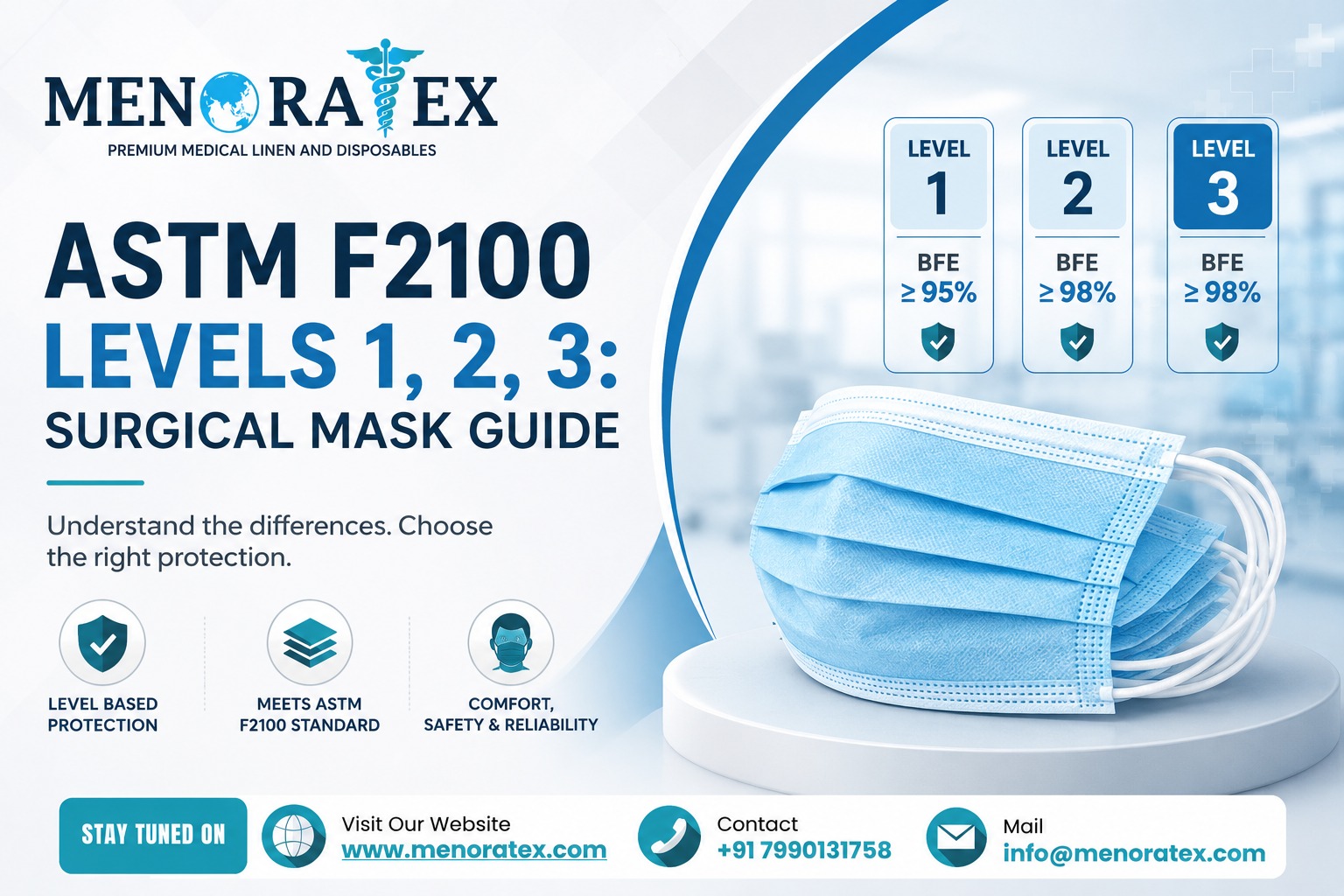
| ASTM Level | Fluid Resistance | Filtration Efficiency (BFE/PFE) | Typical Setting |
|---|---|---|---|
| Level 1 | Lower pressure resistance | ≥95% | Outpatient care, dental clinics, routine examinations |
| Level 2 | Moderate pressure resistance | ≥98% | Minor procedures, moderate-risk clinical tasks |
| Level 3 | Highest pressure resistance | ≥98% | Operating rooms, trauma and orthopedic procedures, high-fluid exposure procedures |
How ASTM F2100 Testing Actually Works
Manufacturers don’t simply assign an ASTM level to a mask. To achieve ASTM F2100 classification, masks must undergo standardized laboratory testing to evaluate their performance across several key criteria.
- Bacterial Filtration Efficiency (BFE): Measures how effectively the mask filters bacteria-sized particles. This test helps assess the mask’s ability to reduce the passage of bacterial contaminants.
- Particulate Filtration Efficiency (PFE): Evaluates the mask’s filtration performance against very small particles, typically in the sub-micron range, providing an indication of its effectiveness against fine particulates.
- Fluid Resistance: Masks are tested using synthetic blood at increasing pressure levels to simulate splash and spray exposure. Higher ASTM levels require greater resistance, with Level 3 masks meeting the highest fluid resistance requirements.
- Differential Pressure (Breathability): Measures the airflow resistance through the mask material. Lower differential pressure indicates better breathability, helping improve comfort during extended wear.
- Flammability: Masks are tested to ensure they meet applicable flammability requirements, supporting safe use in healthcare environments.
A mask is assigned an ASTM F2100 Level 1, Level 2, or Level 3 classification only after it meets the required performance thresholds across these testing categories.
Benefits of Choosing the Correct Mask Level
- Better protection matched to actual risk, rather than a one-size-fits-all approach.
- Regulatory peace of mind during inspections and audits.
- Smarter budgeting, since Level 3 masks typically cost more than Level 1 or 2.
- Improved comfort for staff in lower-risk settings, since higher-filtration masks can be less breathable.
- Consistent supplier quality, when documentation backs up the labeled level.
Step-by-Step: How to Choose the Right Mask Level
- List your clinical settings—outpatient rooms, procedure rooms, operating rooms, etc.
- Estimate fluid exposure risk for each setting realistically, not worst-case.
- Match the setting to a mask level using the guide above.
- Ask suppliers for test documentation, not just a printed level claim.
- Stock multiple levels if your facility handles a range of procedures.
- Review annually, especially if procedure volume or types change.
Common Mistakes to Avoid
- Assuming “surgical mask” always means Level 3. Not all masks marketed as surgical masks meet the highest level—check the actual ASTM rating.
- Buying based on price alone. A cheaper mask with no real ASTM documentation may not perform as claimed.
- Overusing Level 3 everywhere. It’s often unnecessary for low-risk outpatient work and adds unneeded cost.
- Ignoring fit and design. ASTM F2100 tests the mask material, not how the mask fits the face—ear-loop versus tie-on design still matters for perimeter seal, especially at Level 3.
- Forgetting breathability. Higher filtration can mean lower breathability, which matters for staff wearing masks during long shifts.
Best Practices and Expert Tips
- Keep test certificates from your mask supplier on file for compliance checks.
- Match mask design to the setting: ear-loop masks are common and convenient for Level 1–2 use, while tie-on designs are often recommended for Level 3 operating room use because they create a tighter facial seal.
- Train staff on why mask levels differ, not just which one to grab, so they understand the reasoning behind facility protocols.
- Review your mask mix seasonally, especially during periods of higher patient volume or infectious disease activity.
Real-World Example
Picture a multi-specialty outpatient clinic that handles general check-ups, dental work, and occasional minor surgical procedures. Most days, staff wear Level 1 masks for routine visits. When a minor in-office procedure is scheduled, they switch to Level 2 for the added fluid resistance. On the rare occasion a patient needs referral to the clinic’s small procedure suite for something more invasive, staff switch to Level 3.
This tiered approach keeps comfort high on routine days while ensuring the right protection is available when risk increases.
Pros and Cons by Level
Level 1
- Pros: Comfortable, breathable, lower cost
- Cons: Not suitable for moderate or high fluid exposure settings
Level 2
- Pros: Solid middle-ground protection for everyday procedures
- Cons: Still insufficient for heavy spray or splatter environments
Level 3
- Pros: Highest fluid resistance and filtration under the standard
- Cons: Can be less breathable and more costly for routine use
Future Trends in Mask Standards
Mask standards continue to evolve as testing methods improve and supply chains mature:
- Updated particulate testing protocols are refining how filtration efficiency is measured at smaller particle sizes.
- Domestic manufacturing growth is reducing reliance on overseas supply chains after past shortages exposed vulnerabilities.
- Better fit-focused design, including tie-on options, is gaining attention alongside material performance.
- Broader application of filtration frameworks to other PPE categories beyond just face masks.
Staying current with these shifts helps buyers make smarter, more future-proof procurement decisions.
Final Thoughts
ASTM F2100 gives healthcare buyers a clear, tested framework for choosing the right surgical mask—instead of relying on guesswork or marketing claims. Level 1 covers routine, low-risk care. Level 2 handles moderate fluid exposure. Level 3 is reserved for high-risk, fluid-heavy procedures like surgery.
Match the mask to the actual risk of each setting, ask suppliers for real test documentation, and you’ll protect your staff and patients without overspending on unnecessary protection.
Ready to review your mask supply? Audit your current stock against the levels above, confirm your supplier’s test certificates, and adjust your ordering to match your facility’s real-world risk levels.
FAQ Section
Question: What does ASTM F2100 stand for?
Detailed Answer: ASTM F2100 is the Standard Specification for Performance of Materials Used in Medical Face Masks. It’s the U.S. benchmark used to test and classify surgical masks into Levels 1, 2, and 3 based on filtration and fluid resistance performance.
Question: What is the difference between ASTM Level 1 and Level 2 masks?
Detailed Answer: Level 1 masks are designed for low-risk, minimal fluid exposure settings, while Level 2 masks offer stronger fluid resistance and filtration performance, making them suitable for moderate-risk procedures.
Question: What makes a Level 3 mask different from Level 2?
Detailed Answer: The main difference is fluid resistance threshold—Level 3 masks are tested against synthetic blood at a higher pressure than Level 2, making them suitable for high-risk, fluid-intensive procedures like surgery.
Question: Are all surgical masks ASTM F2100 rated?
Detailed Answer: Not necessarily. A mask marketed as a “surgical mask” doesn’t automatically meet a specific ASTM level—buyers should check for documented test results or certification rather than assuming based on the name alone.
Question: Which mask level is required for operating rooms?
Detailed Answer: Level 3 masks are generally required in operating rooms and other high-risk settings involving heavy spray, splatter, or aerosol exposure, since they offer the highest fluid resistance under the standard.
Question: Does a higher ASTM level always mean better comfort?
Detailed Answer: No, often the opposite. Higher filtration and fluid resistance can reduce breathability, so Level 3 masks may feel less comfortable for extended, low-risk daily wear compared to Level 1 or 2.
Question: What tests do masks go through under ASTM F2100?
Detailed Answer: Masks are tested for bacterial filtration efficiency, particulate filtration efficiency, fluid resistance against synthetic blood at set pressures, differential pressure (breathability), and basic flammability requirements.
Question: Can dental clinics use Level 1 masks?
Detailed Answer: Yes, Level 1 masks are commonly used in dental clinics and other low-risk outpatient settings where fluid exposure risk is minimal, though clinics performing more invasive procedures may need higher levels.
Question: Is ASTM F2100 the same as N95 respirator standards?
Detailed Answer: No. ASTM F2100 governs medical face masks focused on fluid resistance and filtration for surgical settings, while N95 respirators follow separate NIOSH standards focused primarily on airborne particulate filtration and fit testing.
Question: How often should ASTM mask standards be reviewed by buyers?
Detailed Answer: It’s a good practice to review your mask supply and supplier documentation at least annually, or whenever the standard is updated, to make sure your facility’s stock still matches current testing requirements and clinical needs.
Contact Us
Feel Free To Contact Us
We are looking for business opportunities to work with. If your requirement matches our products, feel free to get in touch.
Email Id:
info@menoratex.com
kunalsharma888@gmail.com
Contact No.:
+91 7990131758