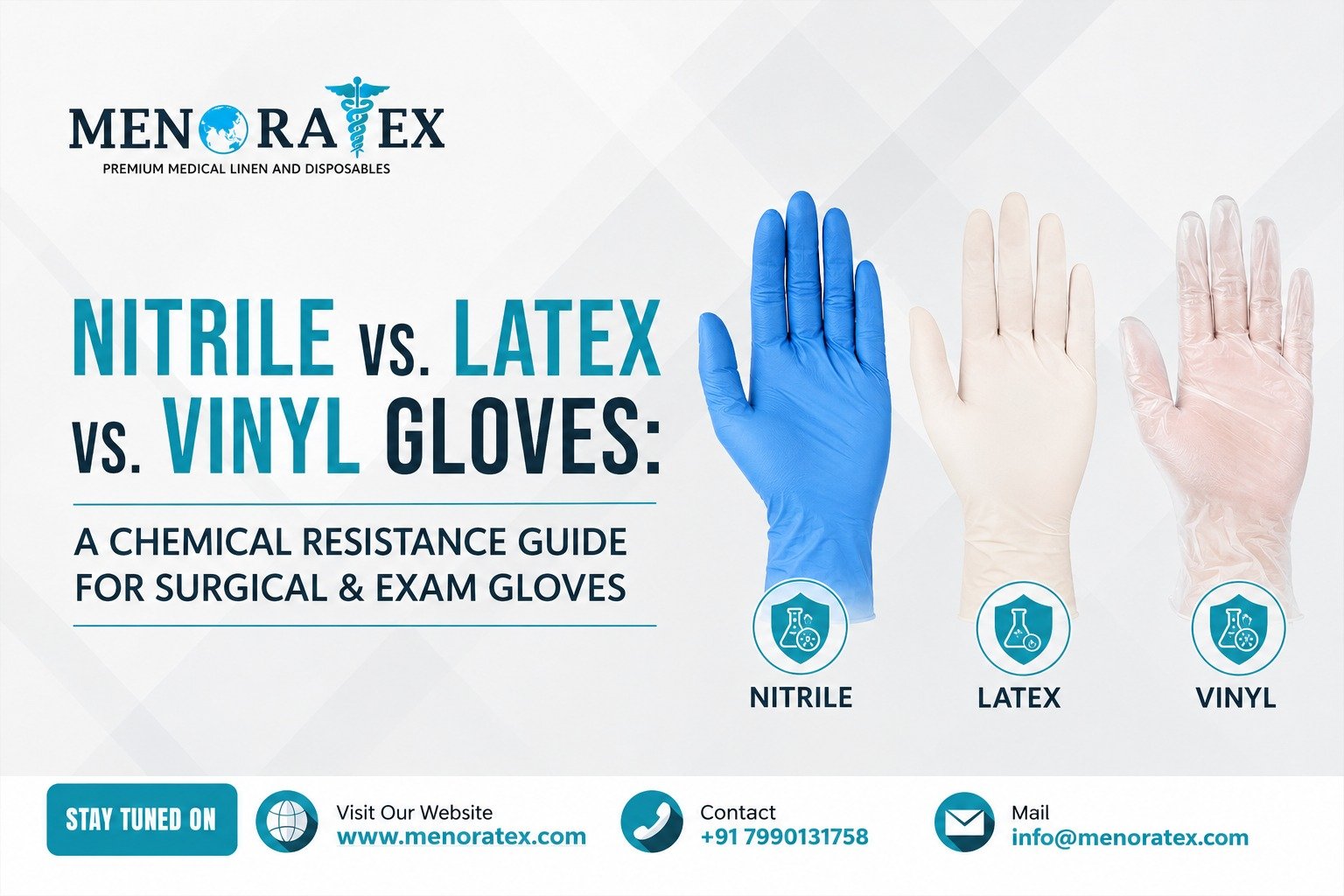
Choosing the wrong exam glove can cost more than a supply budget line item — it can compromise a chemotherapy nurse’s skin barrier, expose a lab technician to a solvent, or trigger a painful allergic reaction in a patient. Yet most buying decisions still come down to price per box and whatever the previous purchasing manager ordered.
That’s a problem, because nitrile, latex, and vinyl gloves are not interchangeable. Each material has a distinct molecular structure, and that structure determines exactly which chemicals it will stop — and which ones will pass straight through in minutes.
This guide breaks down the real chemical resistance differences between the three main glove materials, explains how to read a permeation chart, and gives clinical buyers, lab managers, and healthcare facilities a practical framework for matching glove material to the hazard actually in the room. By the end, you’ll know exactly which glove belongs on your supply shelf for chemotherapy prep, disinfectant use, general exams, and everything in between.
Quick Answer: Which Glove Resists Chemicals Best?
For most clinical and chemotherapy applications, nitrile gloves offer the strongest overall chemical resistance, particularly against oils, solvents, and many cytotoxic drug formulations. Latex performs well against water-based chemicals and biological fluids but degrades quickly when exposed to oils and organic solvents. Vinyl offers the weakest chemical barrier of the three and is best reserved for low-risk, short-duration tasks.
| Glove Material | Chemical Resistance | Chemo Drug Rating | Puncture Resistance | Allergy Risk | Typical Cost per 100 |
|---|---|---|---|---|---|
| Nitrile | High (oils, solvents, many chemo agents) | Often ASTM D6978 rated | High | Very low (no natural rubber proteins) | $8–$14 |
| Latex | Moderate (biological fluids, some acids) | Rarely rated for chemo | Moderate–High | Higher (natural rubber latex allergy) | $6–$10 |
| Vinyl | Low | Not recommended | Low | Very low | $4–$7 |
Featured snippet aside, the real answer depends on the specific chemical, contact duration, and clinical task — which is exactly what the rest of this guide covers.
Why Glove Material Chemistry Actually Matters
Every glove material is built from a different polymer, and each polymer has its own molecular “gaps” that chemicals can exploit. Chemical resistance isn’t about how thick or sturdy a glove feels — a thin nitrile glove can outperform a thick latex one against a specific solvent.
Three factors determine how well a glove protects against a given chemical:
- Permeation rate — how quickly a chemical moves through the glove material at the molecular level, even without visible damage
- Breakthrough time — how long it takes before a detectable amount of chemical passes through to the skin side
- Degradation — physical changes like swelling, cracking, or softening that weaken the glove’s structure
A glove can look completely intact after exposure and still have failed on a molecular level. This is why relying on visual inspection alone is one of the most common — and most dangerous — mistakes in clinical glove selection.
Nitrile Gloves: Chemical Resistance Profile
Nitrile is a synthetic copolymer made from acrylonitrile and butadiene. That synthetic structure is precisely why it has become the standard in oncology units, cleanrooms, and many hospital systems across North America and other developed healthcare markets.
What Nitrile Resists Well
- Oils, greases, and petroleum-based products
- Many organic solvents, including some ketones and alcohols
- A wide range of chemotherapy drugs, including several alkylating agents
- Common disinfectants such as isopropyl alcohol and diluted bleach solutions
- Bloodborne pathogens and biological fluids
Where Nitrile Falls Short
- Strong oxidizing acids can degrade nitrile faster than some buyers expect
- Certain aromatic solvents and some chemo agents still permeate nitrile within short timeframes
- Thickness varies enormously between brands, so a “chemo-rated” claim on one box doesn’t guarantee the same protection on another
Chemo-Rated Nitrile: What the Label Actually Means
When a nitrile glove is marketed as “chemo-tested” or “chemo-rated,” it should reference ASTM D6978, the standard test method for evaluating glove resistance to permeation by chemotherapy drugs. This standard measures breakthrough times for a defined panel of hazardous drugs commonly used in oncology settings.
Important nuance: ASTM D6978 doesn’t test every chemo drug in existence — it tests a representative panel. A glove passing this standard is a strong indicator of protection, but facilities working with less common cytotoxic agents should still check drug-specific permeation data from the manufacturer.
Latex Gloves: Chemical Resistance Profile
Natural rubber latex has been the traditional exam glove material for decades, and its elasticity and tactile sensitivity remain genuinely excellent. Its chemical resistance profile, however, tells a more mixed story.
What Latex Resists Well
- Water-based solutions and diluted acids
- Many biological fluids, making it historically reliable for general exams and minor procedures
- Alcohols in short-duration contact
Where Latex Falls Short
- Oils, fats, and greases cause latex to swell and weaken relatively quickly
- Many organic solvents degrade latex within minutes
- Chemotherapy drug permeation testing on latex is limited, and most oncology guidelines no longer recommend it as a primary chemo barrier
- Natural rubber proteins trigger allergic reactions in a meaningful share of both patients and staff, ranging from mild contact dermatitis to more serious latex allergy responses
The Allergy Factor Clinical Buyers Can’t Ignore
Because latex contains natural proteins, it remains one of the more common sources of occupational contact allergies in healthcare settings. Many hospital systems and outpatient clinics have already shifted to latex-free protocols specifically to reduce liability and protect staff and patients with sensitivities. If your facility still stocks latex, it’s worth confirming your allergy screening and labeling procedures are current.
Vinyl Gloves: Chemical Resistance Profile
Vinyl gloves are made from polyvinyl chloride (PVC), a synthetic material that is loose-fitting and budget-friendly. That affordability, however, comes with a meaningful tradeoff in barrier performance.
What Vinyl Resists Well
- Water-based cleaning solutions
- Short-duration, low-hazard contact tasks like food handling or basic surface wiping
Where Vinyl Falls Short
- Poor resistance to oils, solvents, and most laboratory or pharmaceutical chemicals
- Higher risk of microtears and pinholes, especially with stretching or extended wear
- Not recommended for any chemotherapy, cytotoxic, or hazardous drug handling
- Loose fit reduces tactile precision for detailed clinical tasks
Vinyl still has a legitimate place — short exams, food service in healthcare cafeterias, and general non-hazardous tasks where cost matters more than chemical barrier strength. It should never be treated as a substitute for nitrile or medical-grade latex in any setting involving hazardous chemicals or drugs.
Side-by-Side: Chemical Resistance by Substance
This is the section clinical buyers usually search for directly. Below is a practical comparison across common substances encountered in exam rooms, labs, and oncology units.
| Chemical/Substance | Nitrile | Latex | Vinyl |
|---|---|---|---|
| Isopropyl alcohol (short contact) | Good | Good | Fair |
| Bleach/sodium hypochlorite solutions | Good | Fair | Poor |
| Chemotherapy agents (general) | Good–Excellent (verify ASTM D6978 rating) | Poor | Poor |
| Motor oils, petroleum products | Excellent | Poor | Poor |
| Formaldehyde | Fair–Good | Fair | Poor |
| Acetone and strong ketones | Fair | Poor | Poor |
| Blood and bodily fluids | Excellent | Excellent | Fair–Good |
| Acids (dilute) | Good | Good | Fair |
Always confirm with the manufacturer’s specific permeation data sheet.
Formulations vary by brand and glove thickness, and this table is a general reference point, not a substitute for product-specific testing data.
How to Read a Glove Permeation Chart Correctly
Permeation charts intimidate a lot of first-time buyers, but the logic is straightforward once you know what each column means.
Step-by-Step: Interpreting Breakthrough Time Data
- Locate the chemical you need protection against on the manufacturer’s chart — exact chemical name, not just a category
- Check the breakthrough time, usually listed in minutes; this tells you how long the glove protects before the chemical is detected on the inside surface
- Compare breakthrough time to your actual task duration — a glove with a 60-minute breakthrough time isn’t safe for a 90-minute procedure
- Note the degradation rating, often on a scale describing swelling, cracking, or other physical changes
- Check the glove thickness (mil) tested — thinner exam gloves often have shorter breakthrough times than thicker chemical-handling gloves, even in the same material
- Confirm the test standard used, such as ASTM F739 for general chemical permeation or ASTM D6978 for chemotherapy drugs
Featured Snippet: What Is Breakthrough Time?
Breakthrough time is the amount of time between initial chemical contact with the outside of a glove and the first detectable measurement of that chemical on the inside surface. It is measured in minutes and is the single most important number on a permeation chart for judging real-world safety.
Common Mistakes Clinical Buyers Make
- Assuming “medical grade” means chemical-resistant. Medical grade refers to biocompatibility and barrier standards for bodily fluids, not chemical permeation.
- Judging protection by glove thickness alone. A thicker glove in the wrong material still fails faster than a thinner glove in the right one.
- Double-gloving with the wrong combination. Layering two vinyl gloves doesn’t create nitrile-level protection; it just adds bulk.
- Ignoring degradation signs. Swelling, discoloration, or tackiness are early warning signs that a glove is failing, even before a visible tear appears.
- Reusing gloves between chemical exposures. Once a glove has been exposed to a hazardous chemical, its remaining protective capacity is unknown and shouldn’t be trusted for a second exposure.
- Buying based on price per box instead of task-specific rating. A cheaper glove that fails during a chemo prep task creates far higher downstream costs than the savings on the box.
Best Practices for Selecting the Right Glove
- Match the glove to the specific chemical or drug, not the general task category
- For chemotherapy and cytotoxic drug handling, prioritize gloves tested under ASTM D6978 with published breakthrough times for the specific agents used in your facility
- Change gloves at intervals shorter than the documented breakthrough time, not just when they look worn
- Stock multiple glove types rather than relying on one material for every task across a facility
- Train staff on visual degradation signs in addition to standard glove-change protocols
- Keep manufacturer permeation data sheets accessible at the point of use, not just in a procurement file
Expert Tips for Long-Term Glove Program Management
- Standardize by department, not facility-wide. Oncology, lab, and general exam areas often need different primary glove materials.
- Reassess annually. Glove formulations change, and a brand that scored well two years ago may have reformulated.
- Track near-miss reports. If staff mention a glove felt tacky or degraded early, that’s data worth logging, not dismissing.
- Build allergy screening into onboarding, not just incident response, to catch latex sensitivities before an exposure event.
- Request third-party lab data, not just manufacturer marketing claims, for any glove used in hazardous drug handling.
Cost Considerations
Pricing varies by brand, thickness, and order volume, but general market ranges for exam gloves (per box of 100) typically fall as follows:
- Vinyl: roughly $4–$7 per box — the most budget-friendly option, appropriate for low-hazard tasks
- Latex: roughly $6–$10 per box — mid-range pricing with strong tactile performance
- Nitrile: roughly $8–$14 per box, with chemo-rated or heavier-mil options often priced higher
While nitrile carries a higher upfront cost, many facilities find the total cost of ownership favors nitrile once you factor in reduced exposure incidents, fewer allergy-related claims, and lower liability exposure in chemotherapy and hazardous drug settings.
Budgeting glove purchases by risk category — rather than a single facility-wide material — often reduces overall spend while improving protection where it matters most.
Maintenance and Long-Term Recommendations
Gloves are single-use protective equipment, so “maintenance” here really means program maintenance:
- Store gloves away from direct sunlight and extreme temperatures, which can accelerate material degradation before use
- Rotate stock using a first-in, first-out system, since even unused gloves have a shelf life
- Re-verify supplier certifications annually, since regulatory standards and testing protocols are periodically updated
- Document glove changes during any hazardous drug procedure as part of your facility’s compliance recordkeeping
- Revisit your glove protocol whenever your facility introduces a new chemical, cleaning agent, or drug formulation into regular use
Frequently Asked Questions
Are nitrile gloves better than latex for chemotherapy drugs?
Yes, in most cases. Nitrile gloves generally offer stronger and more consistent protection against chemotherapy agents, and they’re far more likely to carry ASTM D6978 chemo-rated testing than latex gloves.
What is the safest glove for handling hazardous drugs?
A nitrile glove tested and rated under ASTM D6978 for the specific hazardous drugs in use is generally considered the safest option for handling chemotherapy and other cytotoxic medications.
Do vinyl gloves protect against chemicals?
Vinyl gloves offer limited chemical protection and are best suited for low-hazard, short-duration tasks like food handling or basic surface cleaning. They are not recommended for chemotherapy drugs, solvents, or most laboratory chemicals.
Can I double-glove with vinyl instead of using nitrile?
No. Layering two vinyl gloves does not replicate the chemical barrier properties of nitrile. Material chemistry, not glove count, determines resistance to specific chemicals.
How often should chemo-handling gloves be changed?
Gloves should be changed at intervals shorter than the documented breakthrough time for the specific drug in use, and immediately if any tearing, discoloration, or degradation is visible.
Is latex still safe to use in a clinical setting?
Latex remains usable in many low-risk clinical settings, but its natural rubber proteins carry a real allergy risk for both patients and staff, and many facilities have shifted to latex-free protocols as a precaution.
What does ASTM D6978 actually test?
ASTM D6978 is a standardized test method that measures how long it takes for a defined panel of chemotherapy drugs to permeate through a glove material, expressed as breakthrough time in minutes.
Does glove thickness alone determine chemical resistance?
No. Material composition matters more than thickness for chemical resistance. A thin glove in a resistant material can outperform a thick glove made from a material the chemical easily permeates.
Are powder-free gloves more chemical-resistant than powdered ones?
Powder itself doesn’t significantly change chemical resistance, but powder-free gloves are now the standard in most clinical settings due to separate concerns about particulate contamination and allergen exposure.
How do I know if a glove has failed during use, even without a visible tear?
Watch for swelling, softening, tackiness, discoloration, or an unusual odor, all of which can indicate chemical degradation is occurring at the molecular level even before a visible hole appears.
Conclusion
Nitrile, latex, and vinyl gloves are not interchangeable safety equipment — they’re three different chemical barriers with distinct strengths, weaknesses, and real-world failure points. For chemotherapy prep and hazardous drug handling, nitrile gloves tested under ASTM D6978 remain the strongest evidence-backed choice. Latex still has a place in general clinical exams where its tactile sensitivity is valuable, provided allergy risks are actively managed. Vinyl belongs in low-hazard, short-duration tasks only.
The right decision isn’t about picking one “best” glove for the entire facility — it’s about matching each glove material to the specific chemical, drug, and task your team faces every day.
Ready to Standardize Your Facility’s Glove Protocol?
Review your current glove supply against the chemicals and drugs your team actually handles, and update your protocol wherever the material doesn’t match the hazard. A short internal audit today can prevent an exposure incident tomorrow.
Contact Menoratex
Sourcing certified, chemo-rated nitrile, latex, or vinyl gloves for your facility? Menoratex supplies FDA-compliant medical disposables and hospital linens trusted by healthcare providers across the USA, with bulk ordering, custom sizing, and a dedicated focus on U.S. healthcare compliance.
- Email: info@menoratex.com
- Phone: +91 7990131758
- Address: 310, Binori B Square 2, Opposite Hathi Singh ni Vadi, Iscon Ambli Road, Ahmedabad 380054, Gujarat, India