Most linen-buying guides stop at “cotton vs. polyester” and call it a day. That comparison misses the variable that actually determines how a hospital sheet performs on the floor: the weave. Two sheets can be made from identical cotton-poly blends and still behave completely differently under commercial laundering, because one is woven percale and the other is woven sateen.
For facility managers, procurement teams, and healthcare linen suppliers, understanding weave structure — not just fiber content — is the difference between a sheet that survives 150 industrial wash cycles and one that pills, yellows, or tears within a few months.
This guide breaks down exactly what percale weave is, why its structure outperforms sateen and other weaves in commercial healthcare settings, and how to evaluate thread count, GSM, and blend ratios so your next linen order actually holds up under real hospital laundry conditions.
Quick Answer: What Makes Percale the Best Weave for Hospital Sheets?
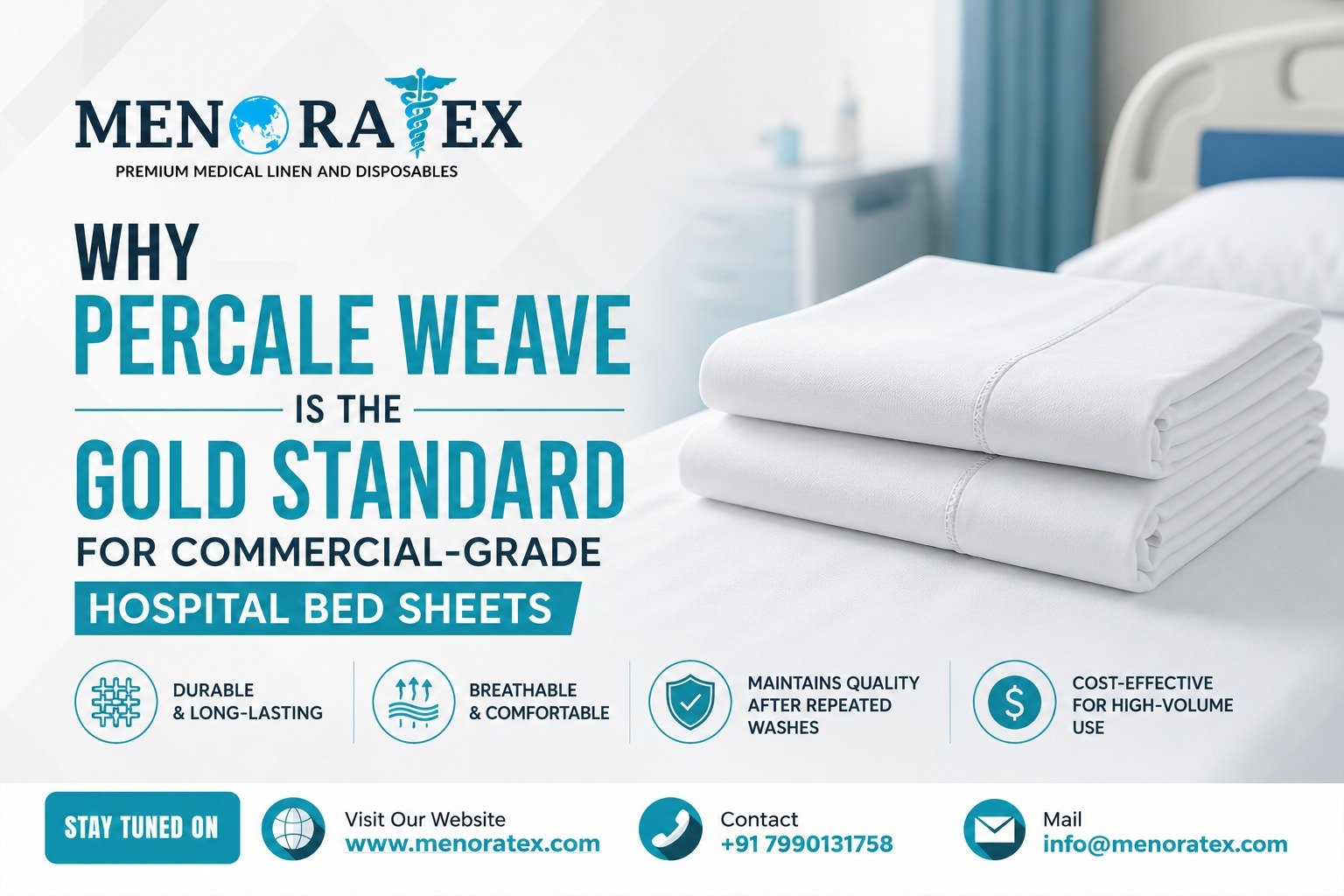
Percale is a plain, one-over-one-under weave that creates a tight, matte, crisp fabric with high dimensional stability. That tight interlacing structure resists pilling, holds up to repeated high-heat industrial laundering, and dries faster than sateen or twill weaves — all of which matter more in a hospital laundry cycle than thread count alone. Percale’s balanced weave also distributes wear evenly across the fabric, extending usable sheet life in high-turnover healthcare environments.
Durability in Commercial Laundering
| Weave Type | Structure | Durability in Commercial Laundering | Feel | Common Use |
|---|---|---|---|---|
| Percale | 1-over-1-under, plain weave | Excellent | Crisp, matte | Hospitals, hotels, healthcare facilities |
| Sateen | 4-over-1-under, satin-style weave | Moderate | Soft, glossy | Retail bedding, boutique hotels |
| Twill | Diagonal rib weave | Good | Textured, durable | Workwear, some commercial linens |
| Jersey (knit) | Knitted, not woven | Poor for institutional use | Stretchy, soft | Casual/home bedding |
Why Weave Structure Matters More Than Thread Count
Thread count gets all the marketing attention, but weave structure determines how those threads actually hold together under stress. A high thread count sateen sheet can still degrade faster in commercial laundering than a moderate thread count percale sheet, because the two weaves distribute mechanical stress completely differently.
The Mechanics of a Plain Weave
Percale uses the simplest weave pattern in textile production: each weft thread passes over one warp thread, then under the next, in a consistent checkerboard-style pattern. This creates:
- Maximum interlacing points per square inch
- A balanced, symmetrical structure with no “float” threads exposed on the surface
- Even distribution of tension across the entire fabric
Sateen, by contrast, uses a weave where each weft thread floats over three or four warp threads before going under one. Those longer “floats” create the soft, lustrous surface sateen is known for — but they also mean more exposed thread surface area, which snags, pills, and abrades faster under repeated commercial washing.
How Percale Performs Under Commercial Laundering Conditions
Hospital linens don’t get washed like home bedding. Commercial and institutional laundry facilities use higher wash temperatures, stronger detergents, tumble-dry cycles, and often steam-pressing or ironing as part of standard turnaround. Percale’s structure is specifically suited to withstand this cycle repeatedly.
Heat and Chemical Resistance
- The tight plain weave holds its shape through repeated exposure to hot water and industrial-strength detergents
- Percale resists the chemical breakdown that causes some looser weaves to thin out or develop holes after dozens of wash cycles
- Bleach-compatible cotton percale blends are common in healthcare settings specifically because the weave tolerates the disinfection protocols hospitals require
Pilling and Abrasion Resistance
Pilling happens when loose fibers on a fabric’s surface rub together and tangle into small balls. Because percale’s weave has minimal float length, there’s less loose fiber surface exposed to friction during washing and drying, which meaningfully reduces pilling compared to sateen or looser weaves over the sheet’s service life.
Dimensional Stability After Repeated Washing
Institutional buyers care about shrinkage and shape retention because ill-fitting sheets on hospital beds create both a safety issue and a professional appearance problem. Percale’s tight, balanced interlacing resists the stretching and shifting that looser weaves experience, helping fitted sheets maintain their corners and elastic fit through hundreds of wash-dry cycles.
Percale vs. Sateen: A Direct Comparison for Healthcare Buyers
| Factor | Percale | Sateen |
|---|---|---|
| Weave structure | 1-over-1-under plain weave | 4-over-1 (or similar) satin-style weave |
| Surface finish | Matte, crisp | Glossy, soft |
| Pilling resistance | High | Lower |
| Drying speed | Faster | Slower (denser thread float) |
| Wrinkle resistance | Moderate | Lower |
| Best fit for high-heat commercial laundry | Yes | Not ideal |
| Typical hospital adoption | Standard | Rare |
Sateen has genuine advantages in retail and boutique hospitality settings, where guests prioritize softness and sheets are laundered less aggressively and less frequently. That equation flips in a hospital laundry facility, where wash frequency and heat exposure are the dominant stress factors — exactly where percale’s structure was built to perform.
Understanding Thread Count and GSM in Percale Sheets
Thread count and GSM (grams per square meter) both matter for percale, but they answer different questions.
Thread Count: What It Actually Tells You
Thread count measures the number of horizontal and vertical threads woven into one square inch of fabric. For percale specifically:
- 180–200 thread count is a common commercial-grade baseline for healthcare linens
- 250–400 thread count percale offers a noticeably crisper, more premium feel while still laundering well commercially
Above roughly 400, returns diminish for percale specifically, since the plain weave structure has a practical density ceiling before it starts affecting breathability
GSM: The Metric Procurement Teams Often Overlook
GSM measures fabric weight and density independent of thread count, and it’s often a better predictor of durability in commercial settings.
- Lighter percale (around 120–140 GSM) dries faster and is common in high-turnover hospital settings where laundry throughput matters
- Heavier percale (150–180+ GSM) offers a more substantial hand-feel and slightly longer service life, at the cost of longer dry times
Best practice: ask suppliers for both thread count and GSM specifications, not just one. A sheet marketed with an impressive thread count but a low GSM may still feel thin and wear faster than expected.
Cotton, Polyester, and Blend Considerations for Percale
Percale is a weave structure, not a fiber — which means it can be woven from 100% cotton, 100% polyester, or a cotton-poly blend. The fiber choice affects performance independently of the weave benefits already covered.
100% Cotton Percale
- Highly breathable, which matters for patient comfort and temperature regulation
- Naturally more prone to wrinkling, requiring more intensive commercial pressing
- Tends to soften slightly over its lifespan without losing structural integrity, thanks to the plain weave
Cotton-Polyester Blend Percale (Common: 50/50 or 60/40)
- More wrinkle-resistant out of the dryer, reducing pressing labor and turnaround time
- Faster drying than 100% cotton, an advantage in high-volume laundry operations
- Slightly less breathable than pure cotton, a trade-off many facilities accept for lower labor costs
100% Polyester Percale
- Most durable against repeated high-heat washing and the fastest to dry
- Least breathable of the three options, which can be a comfort drawback in patient-facing settings
Often reserved for lower-cost, high-turnover facility segments rather than primary patient bedding
Most hospital systems land on a cotton-poly blend percale as the practical middle ground between breathability, durability, and labor-efficient laundering.
Step-by-Step: How to Evaluate a Percale Sheet Supplier
- Confirm the weave, not just the fiber content. Ask suppliers directly whether the product is percale, sateen, or another weave — “cotton sheets” alone doesn’t specify this.
- Request thread count and GSM together, not just one metric, to get a fuller picture of density and weight.
- Ask about wash cycle testing data. Reputable commercial linen suppliers can share how many industrial wash cycles a sheet is rated to withstand before noticeable degradation.
- Check blend ratio for cotton-poly options. A 50/50 blend behaves differently than an 80/20 blend under high-heat laundering.
- Request a sample batch and run it through your facility’s actual laundry protocol before committing to a bulk order — lab specs don’t always match real-world laundry chemistry and equipment.
- Compare cost per wash cycle, not just cost per unit. A slightly higher-priced percale sheet that survives twice as many wash cycles is the better long-term value.
Common Mistakes Facilities Make When Buying Hospital Sheets
- Buying by thread count alone, without confirming weave structure or GSM
- Assuming “percale-style” marketing language means true percale weave — some retail products use the term loosely without the actual 1-over-1 structure
- Choosing 100% cotton for high-turnover units without accounting for the added pressing labor and slower dry times
- Skipping supplier wash-cycle testing data and relying solely on softness or appearance at time of purchase
- Standardizing one sheet type facility-wide instead of matching weave and blend to each unit’s actual laundry volume and patient needs
Best Practices for Long-Term Linen Program Management
Match percale weight (GSM) to each unit’s laundry frequency — lighter for high-turnover units, heavier for lower-turnover comfort-focused areas
- Track average sheet lifespan by wash-cycle count, not calendar time, to make more accurate reorder projections
- Rotate new stock into circulation gradually rather than replacing an entire inventory at once, which helps normalize wear tracking
- Reassess supplier specifications periodically, since fabric sourcing and blend ratios can shift without a change in product name
- Train laundry staff on appropriate wash temperatures and detergent concentrations specific to your percale blend, since over-processing shortens sheet life regardless of weave quality
Cost Considerations
Commercial percale sheet pricing varies by thread count, GSM, and blend, with general per-unit ranges (flat or fitted, standard commercial sizing) typically falling as follows:
- Cotton-poly blend percale (180–200 thread count): roughly $12–$20 per sheet
- Higher thread count blend percale (250–300): roughly $18–$28 per sheet
- 100% cotton percale: roughly $20–$35 per sheet, reflecting both material cost and higher laundering labor
While 100% cotton percale often carries the highest sticker price, many facilities find that cotton-poly blends offer the strongest overall cost-per-wash-cycle value once labor, drying time, and replacement frequency are factored into the total budget.
Frequently Asked Questions
What is percale weave exactly?
Percale is a plain, one-over-one-under weave pattern that creates a tightly interlaced, matte, crisp fabric. It’s considered a weave structure, not a fiber type, and can be made from cotton, polyester, or blends.
Is percale better than sateen for hospital sheets?
Yes, in most commercial healthcare settings. Percale’s tighter weave structure resists pilling and holds up better to high-heat industrial laundering than sateen’s looser, floated weave, making it the more durable choice for institutional use.
What thread count is best for commercial percale sheets?
A range of 180–200 thread count is a common commercial-grade baseline for healthcare linens, while 250–400 thread count offers a more premium feel without sacrificing commercial laundering performance.
Does higher thread count always mean better quality in percale sheets?
Not necessarily. Above roughly 400 thread count, percale’s plain weave structure sees diminishing returns, and GSM (fabric weight) often matters as much or more than thread count for predicting durability.
Is 100% cotton or a cotton-poly blend better for hospital percale sheets?
It depends on the unit’s priorities. 100% cotton offers superior breathability but requires more pressing labor and dries slower, while cotton-poly blends dry faster and resist wrinkling, which many high-turnover facilities prioritize.
How many wash cycles should a commercial percale sheet withstand?
This varies by manufacturer and blend, but reputable commercial suppliers typically provide wash-cycle durability ratings, and facilities should request this data directly rather than relying on thread count alone.
Why does percale resist pilling better than other weaves?
Percale’s plain weave has minimal “float” length, meaning less loose fiber surface is exposed to the friction that causes pilling during washing and drying, compared to weaves like sateen with longer thread floats.
Can percale sheets be bleached?
Many cotton and cotton-poly percale blends are compatible with the bleach-based disinfection protocols common in healthcare laundering, though buyers should confirm specific colorfastness and bleach tolerance with their supplier.
What GSM is ideal for hospital bed sheets?
Lighter percale around 120–140 GSM suits high-turnover units where fast drying matters most, while heavier percale at 150 GSM or above offers a more substantial feel and slightly longer service life for lower-turnover settings.
Does percale wrinkle more than other weaves?
100% cotton percale tends to wrinkle more than cotton-poly blends, which is why many facilities choose a blend specifically to reduce pressing labor and turnaround time in commercial laundry operations.
Conclusion
Weave structure — not thread count or fiber content alone — is what separates a hospital sheet that survives hundreds of industrial wash cycles from one that pills, thins, and needs replacing within months. Percale’s tight, plain weave delivers the durability, pilling resistance, and dimensional stability that commercial healthcare laundering demands, which is exactly why it remains the standard choice across hospitals and healthcare facilities. Sateen and other weaves still have a place in retail and hospitality bedding, but for institutional-grade performance, percale’s structural advantages are difficult to match.
Ready to Upgrade Your Facility’s Linen Program?
Audit your current sheet inventory for actual weave structure, thread count, and GSM — not just marketing labels — and compare that data against your unit’s real laundry volume. A short supplier conversation now can meaningfully extend your linen program’s cost-per-wash value.
Contact Menoratex
Looking for certified, commercial-grade percale hospital bed sheets? Menoratex supplies FDA-compliant hospital linens and medical disposables trusted by healthcare providers across the USA, with bulk ordering, custom sizing, and a dedicated focus on U.S. healthcare compliance.
- Email: info@menoratex.com
- Phone: +91 7990131758
- Address: 310, Binori B Square 2, Opposite Hathi Singh ni Vadi, Iscon Ambli Road, Ahmedabad 380054, Gujarat, India
- Get a Quote: menoratex.com/contact-us
Bulk orders | Custom sizes | U.S. Healthcare Focused