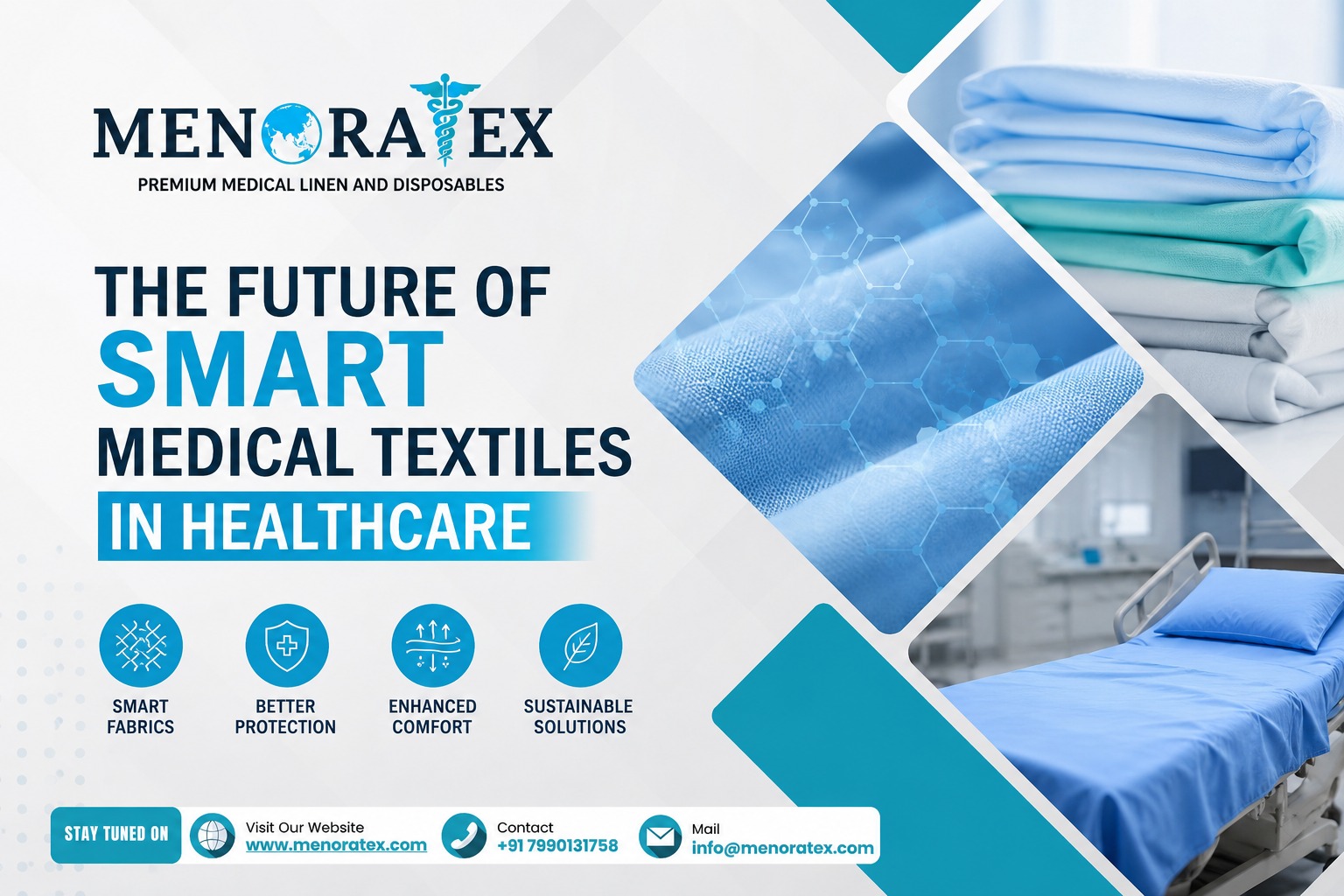
Introduction: Why Textiles Are Becoming the Next Frontier of Digital Health
For decades, hospital textiles — bed sheets, gowns, drapes, and disposables — were judged by three criteria: hygiene, durability, and comfort. That equation is changing. A new category of smart medical textiles is emerging at the intersection of fabric engineering, sensor technology, and healthcare data systems, and it is reshaping how hospitals think about everything from infection control to patient monitoring.
This shift matters to everyone involved in healthcare delivery — not just engineers and researchers, but the procurement officers, infection control nurses, and facility administrators who decide what goes on a hospital bed or a patient’s body every single day. Understanding where smart medical textiles are headed isn’t a futuristic curiosity; it’s becoming a practical part of healthcare planning.
This article breaks down what smart medical textiles actually are, the technologies driving them, the real-world benefits and limitations, and what healthcare buyers should know as the market matures — all explained in plain, procurement-friendly language.
What Are Smart Medical Textiles?
Smart medical textiles are fabrics engineered to do more than cover or protect — they actively sense, respond to, or communicate information about the body or environment they’re in contact with. Unlike traditional hospital linens, which are passive materials, smart textiles incorporate one or more of the following:
• Embedded sensors that detect pressure, temperature, moisture, or movement
• Conductive fibers that transmit electrical signals (for ECG monitoring, for example)
• Antimicrobial or antiviral coatings that actively neutralize pathogens rather than simply resisting them
• Phase-change materials that regulate temperature in response to body heat
• Connectivity components that send data wirelessly to monitoring systems
In short, smart medical textiles sit at the convergence of textile engineering, wearable sensor technology, and healthcare IoT — three fields that, until recently, rarely intersected directly inside a hospital supply closet.
How Smart Textiles Differ From Traditional Hospital Linens
| Feature | Traditional Hospital Linens | Smart Medical Textiles |
|---|---|---|
| Primary Function | Hygiene, comfort, and basic protection | Hygiene, comfort, plus active monitoring or responsive functionality |
| Material Composition | Cotton, cotton-polyester blends, and non-woven disposable fabrics | Conductive yarns, nano-coated fibers, and sensor-integrated woven fabrics |
| Data Capability | None | Can capture vital signs, pressure points, moisture levels, and other patient data |
| Infection Control Method | Passive (regular laundering or single-use disposal) | Active (antimicrobial coatings, real-time contamination detection, and monitoring) |
| Maintenance | Standard hospital laundering cycles | Requires sensor-compatible laundering or limited-use protocols, depending on textile type |
| Cost per Unit | Lower initial cost | Higher initial cost, but designed to reduce long-term healthcare costs by minimizing complications and improving patient monitoring |
This comparison is important for procurement teams: smart textiles are not simply “upgraded” linens. They represent a different category of product with different lifecycle, compliance, and maintenance considerations — a point we’ll return to later.
The Core Technologies Powering Smart Medical Textiles
Embedded Biosensors and Conductive Fabrics
Conductive yarns — often made by weaving silver, copper, or carbon-based fibers into traditional textile bases — allow fabric to carry electrical signals without wires. This is the foundation of wearable medical textiles used for continuous ECG monitoring, respiration tracking, and even early fall detection in elderly care settings.
For hospitals, the appeal is obvious: a patient gown or bedsheet that can quietly track vital signs reduces the need for separate wearable devices, adhesive electrodes, or frequent manual checks — all of which can be uncomfortable, especially for long-stay or critical care patients.
Pressure-Sensing Fabrics for Ulcer Prevention
Pressure injuries (commonly called bed sores or pressure ulcers) remain one of the most persistent — and costly — complications in long-term and acute care. Smart hospital bed sheets embedded with pressure-mapping sensor grids can detect when a patient has remained in one position too long and alert nursing staff before tissue damage begins.
This is one of the clearest examples of smart textiles directly supporting patient-care relevance rather than just operational efficiency. It turns a passive bedsheet into an early-warning system.
Antimicrobial and Nanotechnology-Enhanced Coatings
Infection control has always been central to medical textile design, but smart textiles take this further. Nanotechnology-based coatings — often using silver-ion or copper oxide particles — don’t just resist bacterial growth; many actively neutralize pathogens on contact. Some next-generation fabrics are being engineered to detect contamination, changing color or triggering a sensor alert when bacterial load crosses a threshold.
This convergence of infection control and smart sensing is particularly relevant for hospitals working to reduce hospital-acquired infections (HAIs), a persistent concern across nearly every healthcare system.
Phase-Change and Climate-Responsive Materials
Phase-change materials (PCMs) absorb, store, and release heat as needed, helping regulate a patient’s microclimate — particularly useful for patients with limited mobility who are at higher risk of overheating or pressure-related skin breakdown. While less “high-tech” than sensor fabrics, PCM-integrated textiles are quietly becoming a meaningful comfort and safety upgrade in long-term care.
Connectivity and Data Integration (Healthcare IoT)
The sensing layer is only half the story. For smart textiles to be clinically useful, the data they generate needs to integrate into hospital monitoring systems — feeding into electronic health records (EHRs), nurse call systems, or remote patient monitoring dashboards. This is where healthcare IoT becomes essential infrastructure, and it’s also where many current adoption challenges originate (more on this below).
Why This Matters for Healthcare Procurement Teams
Procurement professionals evaluating smart medical textiles are really evaluating three layered questions:
- Clinical value — Does this measurably improve patient outcomes (fewer pressure injuries, earlier intervention, better monitoring continuity)?
2. Operational fit — Can existing laundering, sterilization, and inventory systems handle sensor-embedded materials without damage or data loss?
3. Total cost of ownership — Does the higher upfront cost offset costs elsewhere (reduced complications, fewer secondary device purchases, lower nursing time spent on manual checks)?
These questions matter because smart textiles, unlike standard hospital linens, often come with lifecycle limitations. A pressure-sensing fabric, for instance, may have a f inite number of safe laundering cycles before sensor accuracy degrades — a very different maintenance profile than a standard cotton-blend sheet rated for hundreds of industrial wash cycles.
This is also why medical textile compliance standards are evolving alongside the technology. Regulatory bodies are still catching up to questions like: How is a sensor embedded gown classified — as a textile, a medical device, or both? What sterilization methods are compatible with embedded electronics? Procurement teams should expect these standards to tighten and clarify over the next several years, and should favor suppliers who track regulatory developments closely.
Real-World and Near-Term Applications
While “smart medical textiles” can sound like a distant innovation, several applications are already moving from research labs into limited clinical use:
• ICU monitoring gowns with embedded ECG and respiration sensors, reducing reliance on adhesive leads that can irritate fragile skin
• Pressure-sensing mattress covers and bed sheets in long-term care and rehabilitation settings
• Antimicrobial surgical drapes with active pathogen-neutralizing coatings, going beyond passive barrier protection
• Smart compression garments for post-surgical recovery, capable of adjusting pressure based on swelling detection
• Fall-detection fabric integrated into bedding and seating for elderly and dementia care facilities
It’s worth noting that adoption is happening unevenly. Acute care and specialized rehabilitation settings are moving faster than general nursing homes or smaller clinics, largely due to budget and technical-support differences. This uneven adoption curve is itself a useful insight for distributors and manufacturers: the next several years will likely see a “bifurcated” market, where high-acuity facilities adopt early and broader healthcare settings adopt later, once costs decrease and laundering/maintenance standards simplify.
Where Smart Textiles Are Likely to Gain Traction First
Looking at adoption patterns across early pilots and published research, certain care settings consistently emerge as the most natural entry points for smart medical textiles:
• Intensive care units, where continuous monitoring is already standard practice and the cost of complications (infection, pressure injury, missed deterioration) is highest
• Post-surgical recovery wards, where swelling, mobility limitations, and infection risk make active-response textiles particularly valuable
• Long-term and palliative care facilities, where patients spend extended periods in bed and pressure injury prevention is a daily operational priority
• Rehabilitation centers, where movement and posture tracking can support physical therapy progress alongside basic comfort
Conversely, general outpatient settings, short-stay surgical centers, and smaller community clinics are likely to see slower adoption — not because the technology lacks value, but because the use case (short patient contact time, lower acuity) doesn’t yet justify the added cost and training overhead. This is a useful filter for any procurement team: the question isn’t “should we adopt smart textiles,” but “where in our facility would smart textiles solve a problem we currently solve with people, time, or separate equipment?”
Challenges and Honest Limitations
A thorough, credible discussion of smart medical textiles has to address the real obstacles facilities face — not just the upside.
Laundering and Sterilization Compatibility
Most hospital textiles undergo industrial laundering involving high heat, strong detergents, and mechanical stress. Many embedded sensors and conductive fibers were not originally designed to survive hundreds of these cycles. This remains one of the most cited practical barriers to widespread adoption.
Cost and Budget Justification
Smart textiles cost meaningfully more than standard linens. For budget-constrained facilities, justifying this premium requires clear outcome data — something the field is still actively generating. Procurement teams are right to ask for evidence, not just innovation marketing.
Data Security and Interoperability
Once a textile becomes a data-generating device, it inherits all the data security and system-integration concerns of any connected medical device. Hospitals already managing complex IT and EHR ecosystems may find that integrating “smart fabric” data streams adds another layer of technical complexity.
Regulatory Ambiguity
As mentioned earlier, classification standards for sensor-embedded textiles are still developing. This creates short-term uncertainty for manufacturers and buyers alike, even as it signals long-term legitimacy for the category.
Training and Workflow Adjustment
New technology requires new training. Nursing staff need to understand how to interpret pressure-sensor alerts or troubleshoot a malfunctioning sensor-embedded gown — an often-overlooked adoption cost.
The Future Outlook: What to Expect Over the Next 5–10 Years
Based on current research trajectories and industry movement, several trends are likely to define the next phase of smart medical textile development:
- Washable, durable sensor integration will improve significantly, narrowing the gap between smart textiles and standard hospital laundering cycles.
2. Cost will decrease as manufacturing scales and more suppliers enter the space, similar to the cost curve seen in other healthcare wearables.
3. Regulatory frameworks will mature, providing clearer classification and compliance pathways — which will, in turn, accelerate procurement confidence.
4. Sustainability will become a parallel priority, with manufacturers exploring biodegradable conductive fibers and recyclable sensor components alongside performance improvements.
5. Hybrid adoption models will likely dominate near-term hospital strategy — facilities combining a smaller volume of smart textiles in high-risk units (ICU, post-surgical, long-term care) with standard textiles elsewhere, rather than full facility-wide replacement.
For healthcare manufacturers and distributors, this suggests the smartest near-term strategy isn’t necessarily racing to develop the most advanced sensor fabric — it’s building reliable, compliant, laundering-compatible textiles that healthcare facilities can trust at scale, while innovation continues incrementally.
A Practical Evaluation Framework for Healthcare Buyers
Given the cost, training, and compliance considerations involved, procurement and clinical leadership teams benefit from a structured way to evaluate whether — and where — smart medical textiles make sense for their facility. The following questions can help frame that internal conversation:
What specific clinical problem are we trying to solve?
Pressure injury rates, infection rates, and monitoring gaps each point toward different smart textile categories. Starting with the problem, rather than the technology, keeps evaluation grounded.
What is our current laundering and sterilization infrastructure?
Facilities using outsourced industrial laundering services may face different compatibility constraints than those with in-house, lower-intensity laundering systems. This should be confirmed with any prospective supplier before purchase.
Do we have the data infrastructure to use the information generated?
A pressure sensing bedsheet is only as useful as the alert system behind it. Facilities should confirm that nurse call systems, EHRs, or monitoring dashboards can actually receive and act on textile-generated data — otherwise the investment underdelivers.
What does a pilot program look like before full-scale purchase?
Given the early stage of standardization in this category, a contained pilot — in one unit or ward — is a lower-risk way to evaluate real-world performance, staff adoption, and laundering durability before committing to facility-wide procurement.
What is the supplier’s track record on compliance and quality documentation?
Because regulatory classification is still evolving, working with established, quality certified medical textile suppliers — rather than newer, unproven entrants — reduces compliance risk during this transitional period.
This framework doesn’t replace clinical judgment or formal procurement policy, but it does help structure what can otherwise be an overwhelming, fast-moving category of product decisions.
Frequently Asked Questions
What are smart medical textiles used for?
Smart medical textiles are used for patient monitoring (vital signs, pressure points, movement), infection control (antimicrobial and pathogen-detecting coatings), and comfort regulation (temperature-responsive materials) in hospital and long-term care settings.
Are smart textiles the same as wearable medical devices?
Not exactly. Wearable medical devices are typically standalone electronics (like a smartwatch or monitor patch). Smart medical textiles integrate similar sensing capabilities directly into fabric — sheets, gowns, or dressings — rather than as a separate attached device.
Can smart medical textiles be laundered like normal hospital linens?
This depends on the specific product. Many current-generation smart textiles have laundering limitations compared to standard linens, which is one of the key adoption challenges hospitals are working through with manufacturers.
Are smart medical textiles cost-effective for hospitals?
Cost-effectiveness depends on the use case. In high-risk settings like ICUs or long-term pressure-injury-prone care, the cost can be offset by reduced complications. For lower-risk general use, traditional textiles often remain more cost-efficient today.
What is the biggest barrier to smart textile adoption in hospitals?
Currently, the most cited barriers are sterilization/laundering compatibility, upfront cost, and regulatory classification clarity — not the underlying sensor technology itself, which has advanced rapidly.
Conclusion: A Gradual, Practical Revolution
Smart medical textiles represent one of the more quietly significant shifts in healthcare technology — not because they replace existing hospital linens and disposables overnight, but because they extend what fabric can do inside a clinical setting. For hospitals, nursing homes, and healthcare distributors, the practical path forward isn’t necessarily full-scale adoption today, but rather staying informed, evaluating high impact use cases first (like pressure injury prevention in long-term care), and partnering with textile suppliers who understand both the innovation and the operational realities of hospital procurement.
As the category matures — with better laundering compatibility, clearer regulatory standards, and more outcome data — smart medical textiles are likely to become a standard part of the broader medical textile and hospital linen ecosystem, rather than a separate, niche category. Facilities that start building familiarity with these products now will be better positioned as adoption accelerates.
Ready to strengthen your facility’s textile foundation?
As smart medical textiles continue to evolve, hospitals and healthcare facilities still rely on dependable, hygiene-focused hospital linens and medical disposables. Get in touch with Menoratex to explore solutions built for patient care today.
Email Id info@menoratex.com
Contact No. +91 7990131758
Explore Menoratex Solutions