Introduction
A glove tearing mid-procedure is more than an inconvenience. It’s a break in the sterile barrier, a contamination risk, and — in a busy clinic or outpatient surgery center — a workflow disruption that costs time and trust.
Most buyers judge exam gloves by thickness or price per box. Few ask the question that actually predicts how a glove behaves under stress: what is its tensile strength, and how was it tested?
This guide breaks down the physical science behind glove tears, explains how tensile strength is measured and reported, and gives procurement teams a practical framework for choosing gloves that hold up in demanding, high-stress environments — from emergency departments to dental suites to industrial cleanrooms.
By the end, you’ll be able to read a glove spec sheet like a materials engineer and ask suppliers the right questions before you commit to a bulk order.
What Tensile Strength Actually Means
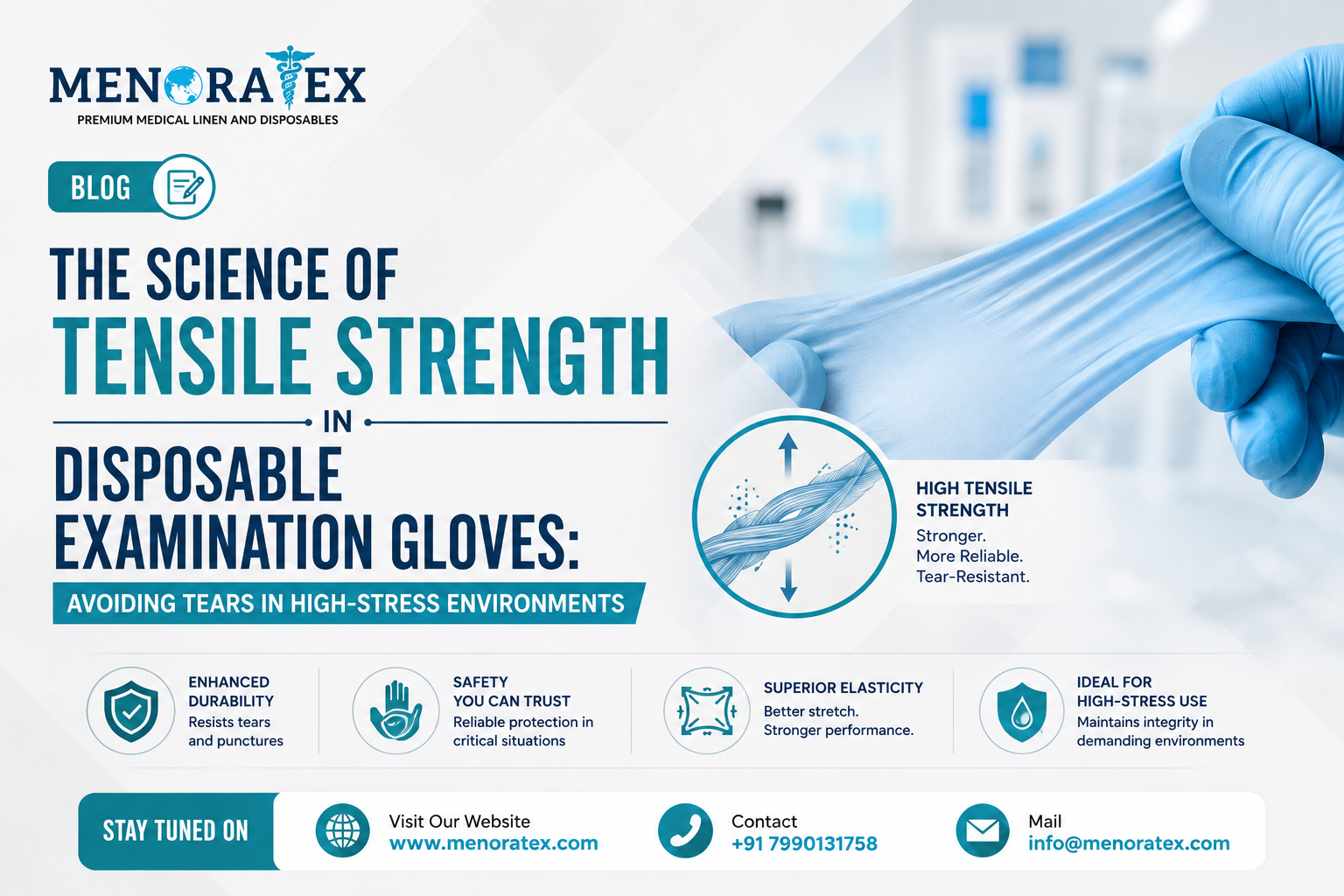
Tensile strength is a measurement of how much force a material can withstand while being stretched before it breaks. For examination gloves, this is typically expressed in megapascals (MPa), following international standards such as ASTM D6319 (nitrile), ASTM D3578 (latex), and ASTM D5250 (vinyl).
Two related but distinct properties are usually reported together:
- Tensile strength: The maximum stress the film withstands before rupture.
- Ultimate elongation: How far the glove material stretches before it tears, expressed as a percentage of its original length.
A glove can have high tensile strength but low elongation, meaning it resists a strong, sudden pull but snaps quickly once stretched past a certain point. Conversely, a highly elastic glove with lower tensile strength may stretch a long way but fail under sharp, concentrated force — the kind that happens when a fingertip catches on a cabinet latch or a suture needle nicks the palm.
For buyers, this distinction matters because “high-stress” isn’t one type of stress. A phlebotomist repeatedly flexing their hand experiences different mechanical demands than a lab technician handling sharp glassware or a groundskeeper pulling on thorny branches.
How Is Tensile Strength Measured?
Tensile strength is measured by clamping a dumbbell-shaped glove sample into a tensile testing machine, stretching it at a controlled speed until it breaks, and recording the force at the breaking point. Results are reported in megapascals (MPa) both before and after accelerated aging, since manufacturers must show the glove still performs after simulated shelf-life degradation.
Why Tears Happen: The Materials Science Behind Glove Failure
Understanding why gloves tear helps explain which specifications actually matter.
1. Polymer Chain Structure
Nitrile, latex, and vinyl gloves are all made from long polymer chains, but those chains are arranged and cross-linked differently. Nitrile’s synthetic rubber structure typically offers a strong balance of puncture resistance and elasticity. Latex, a natural rubber, has excellent elasticity and memory but can vary batch to batch depending on the source material. Vinyl, a PVC-based polymer, generally has the lowest tensile strength and elongation of the three, which is why it’s better suited to low-risk, short-duration tasks than high-stress clinical work.
2. Film Thickness Consistency
Uniform thickness across the palm, fingers, and cuff matters more than headline thickness. A glove listed at 4 mil average thickness but with thin spots at the fingertips (a common weak point from dip-molding inconsistencies) will fail there first, regardless of what the box says.
3. Stress Concentration Points
Tears rarely start mid-palm. They start at:
- Finger seams and crotches (between fingers)
- Cuff edges, especially after repeated donning and doffing
- Areas weakened by micro-punctures from hangnails, jewelry, or sharp instruments
A material can have excellent bulk tensile strength and still fail quickly if these concentration points aren’t engineered for durability.
4. Aging and Storage Conditions
Tensile strength isn’t static. Heat, UV exposure, and prolonged storage degrade polymer chains over time. This is why reputable standards require post-aging tensile testing — measuring strength after the glove has been artificially aged to simulate a year or more on a shelf. A glove that passes fresh-off-the-line testing but wasn’t tested after aging may perform significantly worse by the time it reaches the exam room.
Tensile Strength by Glove Material: A Comparison
| Property | Nitrile | Latex | Vinyl |
| Typical tensile strength (unaged) | 14–24 MPa | 18–30+ MPa | 8–12 MPa |
| Elongation at break | 400–550% | 500–800% | 150–300% |
| Puncture resistance | High | Moderate–High | Low |
| Performance consistency | Very consistent | Batch-dependent | Consistent but lower ceiling |
| Best suited for | High-stress clinical, chemical, industrial use | Fine motor tasks needing high elasticity | Low-risk, short-duration, food-contact tasks |
These are general industry ranges rather than a single fixed number — actual figures vary by formulation, and buyers should always request the specific test data (Certificate of Analysis) for the SKU they’re purchasing rather than relying on category averages.
Benefits of Prioritizing Tensile Strength in Procurement
Choosing gloves based on genuine tensile performance — not just marketing claims — delivers measurable operational benefits:
- Fewer mid-procedure glove changes, which saves clinical time and reduces material waste
- Lower contamination risk, since fewer barrier breaches occur during patient contact
- Reduced re-glove costs, an often-overlooked line item that adds up across a high-volume clinic or ambulatory surgery center
- More consistent staff confidence, since clinicians who trust their gloves move more naturally through procedures
- Better compliance documentation, since verified tensile data supports infection-control audits and accreditation reviews
Key Features to Look for in a Tear-Resistant Exam Glove
Certified Test Data, Not Just Marketing Language
Ask suppliers for the actual ASTM test report showing tensile strength (MPa) and elongation (%) before and after accelerated aging. “Extra strong” on a box is not a specification.
Appropriate AQL (Acceptable Quality Level)
AQL measures pinhole defect rates, not tensile strength directly, but the two are related quality signals. For high-stress or surgical-adjacent use, look for an AQL of 1.5 or lower. General exam use is commonly acceptable at 2.5, but high-stakes environments should prioritize the tighter standard.
Textured Fingertips and Palm
Texturing improves grip, which indirectly reduces tear risk — a secure grip means less accidental snagging, dragging, or overextension of the material during a procedure.
Beaded Cuff Design
A rolled or beaded cuff distributes stress more evenly during donning, reducing the chance of a cuff tear right when the glove is put on — one of the most common failure points reported by clinical staff.
Consistent Fit Across Sizes
A glove that’s too tight stretches the material closer to its elongation limit before any work even begins, leaving less margin before failure. Offering a genuinely accurate range from extra small through extra large (not just S/M/L) reduces this baseline stress.
Step-by-Step: How to Evaluate a Glove’s Tensile Performance Before Bulk Ordering
- Request the Certificate of Analysis (CoA) for the specific lot or SKU, including pre- and post-aging tensile and elongation figures.
- Confirm the testing standard used — ASTM D6319, D3578, or D5250, depending on material — and check the test was performed by an accredited third-party lab.
- Order a sample box and run an informal in-house test: don, stretch, flex at the knuckles, and perform your team’s actual high-stress tasks before committing to volume.
- Check the AQL rating printed on the box or spec sheet and confirm it matches your risk category.
- Ask about aging and storage conditions at the point of manufacture and during transit, especially for international shipments that may sit in variable temperatures.
- Compare thickness consistency claims, not just the average mil rating — ask if finger and palm thickness are measured separately.
- Review batch consistency history with the supplier, particularly for latex, where natural variability is higher.
Common Mistakes When Buying for High-Stress Environments
- Judging quality by mil thickness alone. A thicker glove isn’t automatically stronger; polymer formulation and molding consistency matter more.
- Ignoring post-aging test data. Fresh-glove numbers look good on paper but don’t reflect real shelf performance.
- Choosing vinyl for tasks it isn’t built for. Vinyl works well for short, low-risk contact but is a poor fit for extended high-stress procedures.
- Overlooking fit. Ordering primarily in M/L without accounting for staff with smaller or larger hands increases baseline material stress and tear rates.
- Skipping the AQL check. A low price with a high AQL (meaning more pinhole defects permitted) often costs more later in re-gloving and risk exposure.
- Not testing under real conditions. Lab data matters, but so does a hands-on trial that reflects how your team actually works.
Best Practices and Expert Tips
- Match the glove to the task category, not just the department. A dental hygienist and a dental lab technician handling molds have different mechanical demands even within the same practice.
- Store gloves away from direct sunlight and heat sources. UV and heat exposure accelerate polymer degradation and quietly reduce tensile performance before the glove is even opened.
- Rotate stock using first-in, first-out (FIFO). Gloves sitting in storage for extended periods lose some tensile strength even under ideal conditions.
- Train staff on proper donning technique. Pulling gloves on by the fingertips rather than rolling from the cuff concentrates stress unevenly and increases tear risk at the point of first use.
- Reassess supplier quality quarterly, not just at initial onboarding. Formulation and manufacturing consistency can shift over time even with the same supplier.
Cost Considerations
Tear-resistant, well-documented exam gloves typically carry a modest premium over basic commodity gloves — often in the range of a few cents more per glove, depending on material and order volume. For a mid-sized clinic going through several thousand gloves a month, that premium is usually small compared to the cost of:
- Staff time spent re-gloving mid-procedure
- Additional PPE consumed per contamination event
- Potential compliance or audit findings tied to barrier breaches
- Patient safety incidents linked to exposure events
Buyers evaluating cost per box should instead calculate cost per completed procedure, factoring in tear-related re-gloving rates. A slightly higher per-unit price with a meaningfully lower tear rate frequently comes out ahead on a true cost-per-use basis.
Maintenance and Long-Term Recommendations
Gloves are single-use, so “maintenance” here means protecting performance between manufacture and use:
- Store boxes in a cool, dry area, ideally between 50–77°F (10–25°C), away from direct sunlight
- Keep original packaging closed until use to limit UV and ozone exposure
- Avoid stacking heavy items on top of glove boxes, which can compress and stress the material even before the box is opened
- Track lot numbers so any quality issue can be traced back to a specific batch
- Reassess your supplier’s tensile and elongation data annually, as formulations can be updated over time
Frequently Asked Questions
1. What is a good tensile strength for exam gloves?
For high-stress clinical use, look for nitrile gloves testing above 14 MPa after aging, or latex gloves above 18 MPa after aging, per ASTM standards. Higher figures generally indicate a stronger barrier film.
2. Does glove thickness determine tensile strength?
Not directly. Thickness affects puncture resistance and tactile sensitivity, but tensile strength depends more on polymer formulation and molding consistency than on raw thickness.
3. Why do nitrile gloves tear less often than vinyl gloves?
Nitrile’s synthetic rubber structure generally offers higher tensile strength and greater elongation before breaking, giving it more flexibility to absorb sudden stress without tearing compared to vinyl’s more rigid PVC-based structure.
4. What does AQL mean on a glove box?
AQL, or Acceptable Quality Level, indicates the maximum percentage of gloves in a batch statistically permitted to have pinhole defects. A lower AQL (such as 1.5) signals tighter quality control than a higher one (such as 4.0).
5. How does storage affect glove tensile strength?
Heat, UV light, and humidity accelerate polymer degradation, which can lower tensile strength and elongation over time, even before the box is opened. Cool, dry, dark storage helps preserve original performance.
6. Are powdered gloves stronger than powder-free gloves?
Powder coating doesn’t meaningfully affect tensile strength; it primarily affects donning ease and allergen exposure. Most clinical settings have moved to powder-free gloves regardless of strength considerations, due to allergy and residue concerns.
7. What causes gloves to tear at the fingertips specifically?
Fingertips are often the thinnest point of a dip-molded glove and experience concentrated stress during fine motor tasks, making them a common failure point regardless of overall glove strength.
8. Should latex gloves always be chosen over nitrile for high-stress tasks?
Not necessarily. While latex often shows higher raw elongation figures, nitrile typically offers more consistent batch-to-batch performance and better chemical resistance, making it a common preference for high-stress, high-volume clinical settings.
9. How can a buyer verify a supplier’s tensile strength claims?
Request an accredited third-party Certificate of Analysis showing ASTM-standard tensile and elongation results, ideally including post-aging data, rather than relying on marketing copy alone.
10. Is a higher tensile strength always better?
Not universally. Extremely high tensile strength paired with low elongation can create a glove that resists slow stretching but shatters under sudden sharp force. The best-performing gloves balance both properties for the specific task at hand.
Conclusion
Tensile strength isn’t a marketing buzzword — it’s a measurable, testable physical property that predicts how a glove behaves at the exact moment it matters most: mid-procedure, under real stress. Buyers who look past thickness claims and ask for actual ASTM test data, aging results, and AQL ratings consistently end up with gloves that protect better and cost less over time, once re-gloving and contamination risk are factored in.
The right glove for a high-stress environment isn’t necessarily the thickest or the cheapest. It’s the one backed by verified data showing it holds up when it’s stretched, snagged, and flexed exactly the way your team uses it every day.
Call to Action
Looking for exam gloves with verified tensile strength and consistent, third-party-tested quality? Reach out to the Menoratex team for Certificates of Analysis, bulk pricing, and samples tailored to your facility’s specific high-stress use cases.
Contact Details
- Email: info@menoratex.com | kunalsharma888@gmail.com
- Phone: +91 7990131758