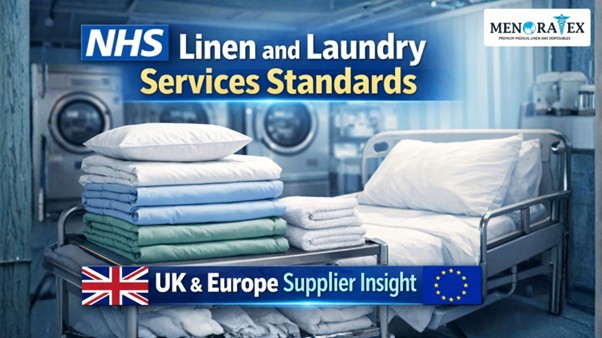
NHS-aligned linen and laundry services require strict infection control, durability, and supplier compliance across UK and European healthcare systems.
Introduction: Why Linen and Laundry Services Deserve Strategic Attention
In healthcare, some systems only get attention when they fail. Linen and laundry services fall squarely into that category. When they work well, they’re invisible. When they don’t, the consequences ripple through infection control, patient safety, staff efficiency, sustainability targets, and budgets.
From a supplier’s perspective, linen and laundry services are not a commodity operation. They are a high-risk, tightly regulated infrastructure that underpins daily hospital function. In NHS Trusts and across European healthcare systems, expectations around performance, traceability, sustainability, and compliance have increased sharply in recent years.
Procurement teams often focus on unit cost. Infection control teams focus on hygiene outcomes. Sustainability leads focus on environmental metrics. What’s rarely addressed is how linen and laundry services sit at the intersection of all three — and how early supplier decisions determine long-term outcomes.
This article offers a supplier-level view into how NHS-aligned linen and laundry services really work, why standards are so demanding, and how healthcare organisations in the UK and Europe can future-proof their approach.
Understanding NHS Expectations for Linen and Laundry Services
The NHS does not treat linen and laundry services as a background function. They are governed by strict guidance, audit requirements, and performance expectations because linen is a direct patient-contact surface.
From a supplier standpoint, NHS-aligned linen and laundry services must deliver:
- Consistent hygiene outcomes across high volumes
- Compatibility with thermal disinfection processes
- Reliable availability under extreme operational pressure
- Traceability and accountability at item level
- Alignment with sustainability and waste-reduction goals
What many outside procurement don’t realise is that NHS standards influence healthcare systems well beyond the UK. Across Europe, NHS frameworks are often used as a reference point for public healthcare tenders, particularly where infection control and risk management are prioritised.
For suppliers, designing products and systems that support linen and laundry services at NHS scale requires experience, not theory.
The Supplier’s Role in the Linen Lifecycle
Suppliers are often viewed as the starting point of linen and laundry services, but in reality, they’re embedded throughout the lifecycle.
From our perspective, effective linen and laundry services depend on early decisions in:
- Fibre selection
- Fabric construction
- Stitching and seam reinforcement
- Colour fastness and shrinkage control
- Compatibility with industrial detergents and temperatures
Linen designed without an understanding of real laundry environments fails faster, sheds fibres, and increases infection risk. In high-pressure NHS environments, every weakness is amplified by volume.
Suppliers who understand linen and laundry services as an operational system — not just a product delivery — help Trusts reduce replacement rates, manage costs, and maintain compliance.
Infection Control: The Non-Negotiable Core of Linen and Laundry Services
Infection control is the foundation of all NHS linen and laundry services. There is no flexibility here.
Linen is exposed to blood, bodily fluids, and pathogens daily. NHS laundering processes are designed to achieve thermal and chemical disinfection, often aligned with HTM guidance. These processes are intentionally aggressive — and they destroy poorly designed textiles.
From a supplier viewpoint, infection control risk increases when:
- Fabrics degrade and thin over time
- Broken fibres trap microorganisms
- Seams fray and retain contaminants
- Linen exceeds its safe lifecycle
One harsh truth procurement teams sometimes miss: aging linen increases infection risk, even if washing protocols are followed. This is why proactive replacement planning is a critical part of effective linen and laundry services.
Across Europe, healthcare providers increasingly mirror NHS infection control benchmarks because they are proven under pressure.
Sustainability in Linen and Laundry Services: Beyond Marketing Claims
Sustainability is now central to healthcare decision-making, but it is often misunderstood. In linen and laundry services, sustainability is not achieved through labels or recycled fibres alone.
True sustainability comes from lifecycle performance.
From supplier data across the UK and Europe, the most sustainable linen and laundry services share common traits:
- Longer linen lifespan
- Reduced replacement frequency
- Lower energy consumption per use
- Optimised wash formulas
- Reduced textile waste
Cheap linen replaced frequently creates more environmental harm than durable linen with a higher upfront cost. This is a difficult truth in price-driven tenders, but sustainability metrics increasingly reflect it.
As healthcare systems move toward sustainable healthcare models, linen and laundry services are becoming a measurable contributor to environmental performance rather than an afterthought.
RFID Technology: A Turning Point for Linen and Laundry Services
One of the most significant advances in linen and laundry services has been the adoption of RFID technology.
RFID technology transforms linen from an anonymous asset into a data source. When implemented properly, RFID technology enables healthcare providers to:
- Track usage by ward or department
- Monitor wash cycle counts per item
- Identify loss and shrinkage patterns
- Forecast replacement needs accurately
- Strengthen infection control traceability
From a supplier perspective, RFID technology also improves product design. Real-world performance data reveals which items fail early and why, allowing continuous improvement.
Across the UK and Europe, RFID technology is moving from optional to expected in advanced linen and laundry services operations.
Operational Reality: Why Linen and Laundry Services Are So Complex
Behind the scenes, linen and laundry services operate at enormous scale. Millions of items circulate through hospitals, laundries, and logistics networks every week.
Common operational challenges include:
- Linen loss between wards and laundries
- Improper segregation of soiled items
- Damage from incorrect wash processes
- Manual counting errors
- Overstocking to compensate for shrinkage
Without visibility, hospitals often respond by ordering more linen, driving up costs and waste. This reactive approach undermines both sustainability and efficiency.
Supplier-laundry collaboration is critical here. When suppliers understand laundry workflows — and laundries understand textile construction — linen and laundry services operate more predictably and safely.
Compliance, Audits, and Accountability
NHS-aligned linen and laundry services are subject to intense scrutiny. Audits can cover:
- Manufacturing processes
- Material sourcing
- Quality assurance records
- Ethical labour compliance
- Environmental documentation
From a supplier standpoint, compliance is not a one-time exercise. Documentation must be audit-ready at all times.
Across Europe, public healthcare procurement increasingly mirrors NHS audit expectations. Suppliers without operational depth struggle to meet these requirements consistently.
This is where EEAT matters in practice: experience, expertise, authoritativeness, and trustworthiness must be demonstrable — not claimed.
Why Price-Only Procurement Weakens Linen and Laundry Services
A blunt truth: price-driven procurement often damages linen and laundry services in the long run.
Low-cost linen typically leads to:
- Shorter usable life
- Higher infection control risk
- Increased replacement volumes
- Greater environmental impact
- Higher total cost of ownership
Healthcare providers across the UK and Europe are slowly shifting from vendor selection to partner selection. Experienced suppliers design linen for NHS-level abuse, not showroom presentation.
In linen and laundry services, the cheapest option is rarely the most economical.
Linen and Laundry Services as Part of Sustainable Healthcare Strategy
As healthcare systems pursue sustainable healthcare, operational functions are under greater scrutiny. Linen and laundry services now contribute directly to sustainability reporting, carbon reduction plans, and ESG targets.
Durable textiles, efficient laundering, RFID technology, and data-driven replacement planning all support sustainable healthcare goals. When aligned correctly, these elements reduce waste, energy use, and operational friction simultaneously.
Suppliers who understand this alignment help healthcare providers meet regulatory expectations without compromising safety or availability.
What Forward-Thinking NHS and European Providers Are Doing Now
Leading organisations are already evolving their linen and laundry services by:
- Integrating RFID technology at scale
- Shifting evaluation toward lifecycle cost
- Embedding sustainability metrics into tenders
- Engaging suppliers earlier in planning
- Treating linen as infrastructure, not inventory
These providers understand that resilient linen and laundry services support patient dignity, staff efficiency, and regulatory confidence.
Conclusion: Linen and Laundry Services Are Not a Background Function
Linen and laundry services underpin infection control, sustainability, and operational resilience in healthcare. NHS standards represent one of the highest global benchmarks — and for good reason.
From a supplier’s perspective, success in linen and laundry services comes from experience, transparency, and long-term thinking. When healthcare providers choose partners who understand NHS realities, they reduce risk across every dimension that matters. As expectations rise across the UK and Europe, those who treat linen strategically will outperform those who treat it as an afterthought.
Frequently Asked Questions
1. Why are NHS linen and laundry services standards so strict?
Because linen directly affects infection control, patient safety, and regulatory accountability.
2. How does RFID technology improve linen and laundry services?
It increases visibility, reduces loss, and supports better hygiene and replacement decisions.
3. What makes linen sustainable in healthcare settings?
Longevity, durability, and reduced replacement — not just recycled materials.
4. Can NHS linen standards apply across Europe?
Yes. Many European systems use NHS benchmarks as best practice.
5. Why involve suppliers early in linen planning?
Early collaboration prevents costly mistakes and improves long-term performance.
Why the Right Linen Partner Matters
Healthcare providers across the UK and Europe are under increasing pressure to optimise linen and laundry services while meeting strict infection control, sustainability, and compliance standards. In this environment, outcomes depend not only on internal processes, but on the capability of the supplier behind them.
This is where experienced partners make a measurable difference.
Menoratex works alongside healthcare providers and commercial laundries to support NHS-aligned linen and laundry services, focusing on durability, compliance, and long-term performance rather than short-term cost savings. By understanding how textiles behave across high-intensity laundry cycles, infection control protocols, and sustainability requirements, Menoratex helps organisations reduce risk and improve operational stability.
Rather than treating linen as a commodity, Menoratex supports healthcare teams with insights that connect product design, laundry performance, RFID technology integration, and sustainable healthcare objectives.
For procurement and estates teams reviewing their current linen strategy, early supplier involvement can prevent costly inefficiencies and compliance gaps later on.
Email (Primary): info@menoratex.com
Email (Secondary): kunalsharma888@gmail.com
Phone: +91 7990131758