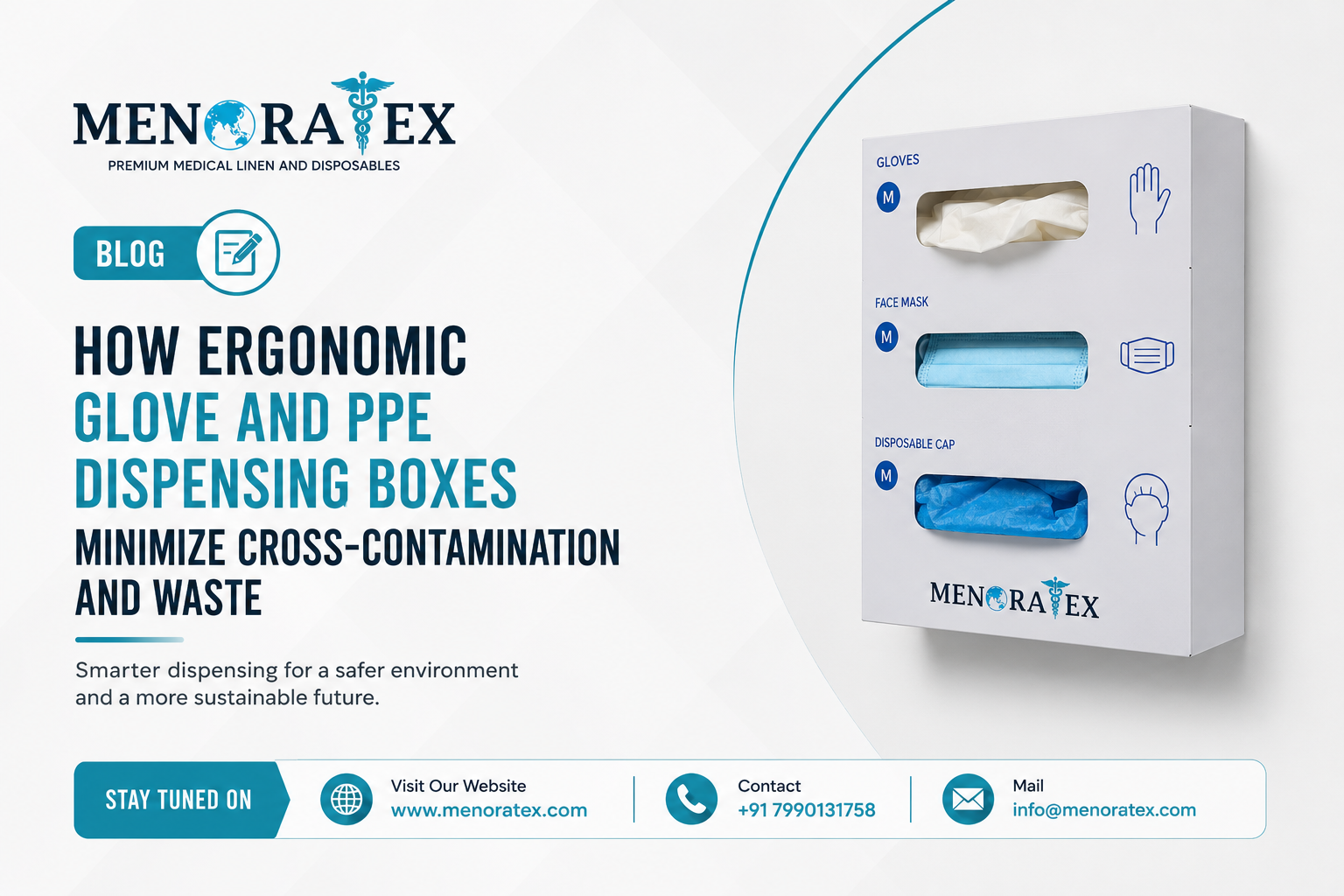
Walk into almost any exam room, and you’ll notice the same small drama playing out dozens of times a day. A nurse reaches for a glove, and three gloves come out instead of one. A box sits at an awkward angle on a shelf, so staff end up touching the box, the counter, and the supply cart before they ever touch the patient. By the end of the month, the supply closet is short, the trash bin is full of unused gloves, and nobody can quite explain why.
The truth is that most facilities lose more PPE to poor dispensing design than to actual patient care. A flimsy, oversized, or badly positioned glove box doesn’t just waste product. It creates extra touchpoints, and every extra touchpoint is a chance for cross-contamination.
This guide looks at the packaging and workflow side of medical disposables — specifically how ergonomic glove and PPE dispensing boxes are engineered to solve both problems at once. If you’re a clinic manager, facilities director, or procurement lead evaluating bulk PPE suppliers, this breaks down exactly what to look for and why it matters more than most buyers realize.
Why Dispensing Design Is a Patient Safety Issue, Not Just a Convenience One
Infection control protocols spend a lot of attention on glove material, sizing, and donning technique. Far less attention goes to the box the gloves come out of, even though the box is where the first contamination risk actually happens.
Consider the sequence of a routine glove change. A staff member removes contaminated gloves, sanitizes their hands, and reaches for a fresh pair. If the dispenser requires digging, pinching, or pulling multiple gloves free of a tangled stack, that clean hand is now touching the box surface, possibly multiple gloves, and whatever surface the box happens to be sitting on. The Centers for Disease Control and Prevention has long identified hand hygiene breaks like this as a leading contributor to healthcare-associated infections, and the dispensing step is one of the most overlooked breaks in that chain.
A well-designed dispenser addresses this at the mechanical level:
- Single-glove extraction so one pull yields one glove, not a fistful
- A stable, fixed opening that keeps the glove edge accessible without requiring staff to reach inside the box
- A shape and weight that stays put on a counter or in a wall mount instead of tipping or sliding
None of this is cosmetic. It’s applied ergonomics, and it directly reduces the number of times a hand touches something other than the glove it needs.
The Waste Problem Nobody Budgets For
Ask any practice manager what their biggest PPE cost driver is, and most will say “usage went up.” Fewer will mention dispensing waste, yet it’s often a significant hidden line item.
Here’s what tends to happen with poorly designed boxes:
- Multi-glove pulls. A tight or torn dispensing slot pulls two or three gloves out at once. Staff either use extras unnecessarily or discard the ones that touched a non-sterile surface.
- Torn or unusable gloves. Cheap cardboard boxes with jagged dispensing slots snag glove cuffs, tearing them before they’re even worn.
- Box collapse and spillage. Overstuffed or structurally weak boxes crush under stacking, and gloves near the bottom become contaminated or unusable.
- Improper storage habits. When a box doesn’t fit cleanly into a wall dispenser or cart slot, staff improvise — leaving loose boxes on counters where they’re exposed to splashes, dust, and constant hand contact.
Multiply any one of these by a busy outpatient clinic seeing 40+ patients a day, and the monthly glove bill climbs fast, often without anyone connecting the dots back to the dispenser itself.
Quick tip: If your team frequently reports “the box is empty again” faster than expected, don’t assume usage increased. Audit for multi-glove pulls first — it’s the single most common hidden waste source.
What Makes a Glove or PPE Box Genuinely Ergonomic
“Ergonomic” gets used loosely in packaging marketing, so it helps to know what actually separates a well-engineered dispensing box from a standard one.
Dispensing Opening Design
The opening should be sized and shaped to release one glove cuff at a time without forcing staff to pinch, dig, or shake the box. Reinforced or die-cut openings with a slight taper hold the stack in place while still releasing smoothly.
Box Rigidity and Stack Support
A rigid outer shell — whether corrugated cardboard, reinforced paperboard, or polypropylene — keeps its shape under the weight of a full glove stack and under normal handling. This prevents the box from folding in on itself, which is what usually causes multi-glove pulls in cheaper packaging.
Footprint and Mounting Compatibility
Standard exam glove boxes are generally sized to fit universal wall-mount holders and cart-mounted triple dispensers common across North American clinics and hospitals. A box that’s even slightly off-spec forces staff to store it loose, which defeats the purpose of a wall dispenser entirely.
Surface and Material Considerations
Boxes intended for clinical environments increasingly use moisture-resistant coatings or laminated finishes, since standard cardboard absorbs splashes and becomes a bacterial reservoir over time. This matters especially in high-splash zones like phlebotomy stations or dental operatories.
One-Handed Access
In many clinical tasks, one hand is occupied — holding a patient’s arm steady, holding an instrument, or maintaining sterile field. A box designed for true one-handed dispensing (stable base, accessible opening at a comfortable height when wall-mounted) keeps workflow moving without requiring staff to set something down first.
Comparing Dispensing Formats
| Format | Best For | Contamination Risk | Typical Waste Level |
|---|---|---|---|
| Standard cardboard box, loose on counter | Low-volume settings | Higher — exposed to splashes and multiple hand contacts | Moderate to high |
| Wall-mounted single-box holder | Individual exam rooms | Lower — box is enclosed and elevated | Low |
| Triple/quad glove dispenser rack | Multi-size rooms (S/M/L stocked together) | Low — reduces wrong-size grabbing and cross-touching | Low |
| Cart-mounted dispensing unit | Mobile care, home health, EMS | Low, if unit is enclosed | Low to moderate |
| Reinforced moisture-resistant box | High-splash zones (dental, phlebotomy, ORs) | Lowest | Lowest |
Step-by-Step: Evaluating a Glove or PPE Dispenser Before You Order in Bulk
- Check the dispensing slot under load. Fill a sample box fully and test pulling gloves one at a time. If you regularly pull two or more, that’s a design flaw, not a fluke.
- Test mounting compatibility. Confirm the box dimensions match your existing wall or cart holders. Even a half-inch mismatch causes staff to skip the holder.
- Assess rigidity when half-full. Boxes often perform fine when full and fail once the stack drops below the halfway mark. Test at 50% capacity, not just at full capacity.
- Review the outer material for splash zones. For rooms with frequent fluid exposure, ask suppliers specifically about moisture-resistant or laminated box options.
- Confirm carton-to-box packing ratios. Bulk orders should specify how many individual dispenser boxes come per shipping carton, since this affects storage planning and reorder timing.
- Request a small trial order. Before committing to a full bulk shipment, order a trial case and have frontline staff — not just procurement — test it for two weeks.
Common Mistakes Facilities Make With PPE Dispensing
- Buying purely on price per box without factoring in waste from multi-glove pulls, which can erase any savings within a few months.
- Ignoring box-to-holder fit, leading staff to store boxes loose on counters, increasing contamination touchpoints.
- Overstocking too high on shelving, which crushes lower boxes in a stack and damages dispensing openings before they’re even opened.
- Skipping supplier documentation on material composition, especially for facilities that need traceable, compliant sourcing for accreditation audits.
- Not training new staff on proper one-handed dispensing technique, which negates even a well-designed box.
Best Practices for Facilities Managing PPE at Scale
- Standardize on one dispenser box format across departments where possible, so wall holders and reorder specs stay consistent.
- Place wall-mounted dispensers at a height and angle that supports one-handed access without staff needing to lean or twist.
- Rotate stock using first-in, first-out placement so older cartons are dispensed before newer ones, reducing the odds of long-term storage weakening box structure.
- Pair bulk glove orders with matching mask, gown, and shoe cover dispensing systems so the whole PPE station follows the same low-touch logic.
- Build a simple monthly audit — even five minutes per exam room — checking for torn openings, loose boxes on counters, or overfilled holders.
Expert Tips From the Supply Chain Side
Procurement teams that source PPE at scale for multi-location clinics or hospital systems tend to agree on a few things that don’t always show up in general buying guides:
- Ask for the box’s collapse-load rating, especially if boxes will be stacked more than three high in storage.
- Request samples in the exact size range you order most (small and medium move fastest in most outpatient settings), since dispensing performance can vary slightly by size due to material thickness.
- Confirm reorder lead times up front. Facilities that source from overseas manufacturers should build in buffer stock for shipping timelines, particularly around peak flu season demand spikes.
- Look for suppliers who can provide consistent box specifications across production runs. Inconsistent box dimensions between batches is a common, underrated cause of dispensing problems.
Cost Considerations
Pricing for ergonomic glove and PPE dispensing boxes varies by material, glove type, and order volume, but a few general patterns hold across the North American market:
- Standard cardboard exam glove boxes typically run $4–$9 per box at retail volumes, dropping meaningfully with case and pallet quantities.
- Reinforced or moisture-resistant boxes carry a modest premium, often 10–20% above standard cardboard, but this is frequently offset by reduced waste from torn gloves and box failures.
- Wall-mount and cart dispenser hardware is typically a one-time capital cost, ranging from roughly $10 for a single holder to $40–$60 for multi-size cart units, and lasts for years with normal wear.
- Bulk direct-from-manufacturer sourcing, especially for facilities ordering by the pallet, generally brings per-box costs down significantly compared to distributor markups, though minimum order quantities and shipping lead times need to be factored into total cost planning.
The math that matters most, though, isn’t the sticker price — it’s cost per glove actually used for patient care versus cost per glove wasted through poor dispensing. Facilities that switch to properly engineered dispensing boxes commonly report noticeably lower monthly glove consumption without any change in patient volume.
Maintenance and Long-Term Recommendations
- Inspect wall-mount holders quarterly for cracked plastic or loose mounting hardware, since a wobbly holder undermines even the best box.
- Replace dispenser holders that no longer grip boxes snugly — a loose fit is what causes boxes to slide or tip during use.
- Keep a small buffer stock (typically 2–4 weeks of usage) to avoid emergency reorders that force staff to use whatever’s available, including mismatched or lower-quality substitute boxes.
- Periodically re-survey staff on dispensing friction points. Frontline feedback catches design or fit problems procurement rarely sees firsthand.
- Review supplier packaging specs annually, since manufacturers do occasionally adjust box dimensions or materials — worth confirming compatibility stays consistent before a large reorder.
FAQs
1. What makes a glove box “ergonomic” compared to a standard box?
An ergonomic glove box is engineered so a single glove can be pulled out cleanly without pinching, digging, or dislodging extras, and it’s shaped and sized to fit standard wall or cart mounts for one-handed access.
2. How much PPE waste is actually caused by bad dispensing design?
There’s no single universal figure, since it varies by facility and box quality, but multi-glove pulls and torn gloves from poor dispensing slots are consistently cited by supply chain teams as a leading, under-tracked source of PPE overconsumption.
3. Do moisture-resistant glove boxes cost significantly more?
Typically only modestly more than standard cardboard, and the added durability often pays for itself by preventing torn gloves and box collapse in high-splash areas like dental or phlebotomy stations.
4. Can any glove box fit a standard wall-mounted dispenser?
Not always. Box dimensions vary slightly between manufacturers, so it’s worth confirming compatibility with your existing mounts before placing a large bulk order.
5. How often should dispenser boxes be restocked to avoid contamination?
Restocking frequency depends on patient volume, but the bigger contamination risk usually comes from letting boxes run near-empty and get handled excessively, rather than from the restocking interval itself.
6. What’s the difference between a triple dispenser and a single wall-mount holder?
A triple dispenser holds small, medium, and large gloves side by side, reducing the chance staff grab the wrong size or touch multiple boxes searching for the right one. A single holder is simpler but works best in rooms that only stock one glove size.
7. Are cardboard or plastic dispenser boxes better for infection control?
Both can work well if properly designed. Reinforced cardboard with a moisture-resistant coating performs comparably to rigid plastic in most settings, though plastic holders often outlast cardboard boxes over repeated use in high-splash zones.
8. How do I know if our facility is losing money to dispensing waste?
A simple audit works: track glove usage against patient volume for a month, and separately note how often staff report multi-glove pulls or torn gloves. A mismatch between usage and patient volume is a strong signal.
9. Should dispensing box design be part of a formal procurement checklist?
Yes. Many procurement checklists focus heavily on glove material and certification but skip dispensing performance entirely, which is a gap worth closing given how much it affects real-world waste and contamination risk.
10. What should I ask a bulk PPE supplier about their dispensing boxes?
Ask about collapse-load rating, dimensional consistency across production runs, moisture resistance options, and case-to-carton packing ratios — these four details predict dispensing performance better than price alone.
Conclusion
The dispensing box is easy to overlook because it’s not the product itself — it’s just what the product comes in. But in a clinical setting, that box is part of the infection control chain, and a poorly designed one quietly drives up both contamination risk and monthly supply costs. Facilities that treat dispensing design as seriously as they treat glove material tend to see the payoff in fewer torn gloves, fewer multi-glove pulls, and a supply budget that actually matches patient volume.
Ready to Source Better-Engineered PPE Packaging?
If your clinic, hospital, or care network is evaluating bulk suppliers for gloves and PPE, packaging design is worth putting on the checklist alongside material and certification. Menoratex supplies hospital-grade disposables — including nitrile, latex, and vinyl exam gloves — engineered for reliable, low-waste dispensing at scale.
Contact Us
📧 info@menoratex.com
📧 kunalsharma888@gmail.com
📞 +91 7990131758
🔗 Request a bulk quote: menoratex.com/contact-us