Introduction
Most conversations about operating room safety focus on sterility — gloves, gowns, drapes, hand hygiene. Static electricity rarely comes up, yet it’s a real and measurable hazard in modern surgical suites. Every time nonwoven fabric rubs against skin, hair, or another textile, it can generate an electrostatic charge. In a room full of oxygen-rich environments, flammable prep solutions, and sensitive electronic monitoring equipment, that charge isn’t just an annoyance — it’s a documented safety risk.
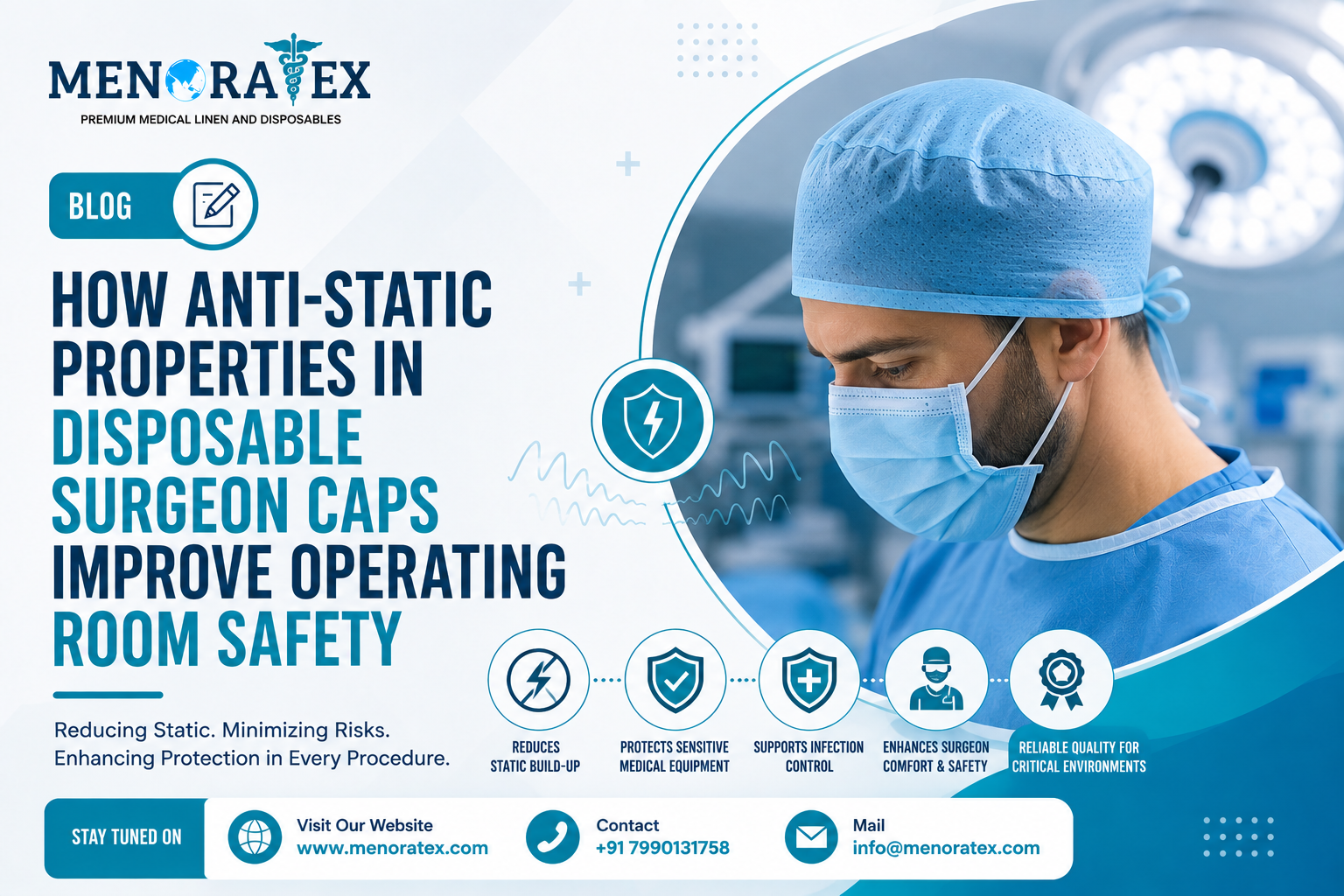
Disposable surgeon caps are one of the most overlooked pieces of this puzzle. Worn on every case, in direct contact with hair and scalp, standard nonwoven caps can build up static charge throughout a shift. Anti-static (or ESD-safe) surgeon caps are engineered specifically to prevent that buildup, and understanding how they work — and when they’re truly necessary — is essential for anyone responsible for OR supply decisions.
This guide walks through what causes static buildup in the OR, how anti-static surgeon caps are engineered to prevent it, which fabric standards and certifications matter, and how to evaluate and source the right product for your facility.
Why Static Electricity Is a Safety Issue in the Operating Room
The Physics Behind the Risk
Static charge builds up through triboelectric charging — the transfer of electrons that happens when two dissimilar materials contact and separate repeatedly. Synthetic nonwoven fabrics, like the polypropylene commonly used in disposable caps, are especially prone to this because they’re poor conductors. Without a path for the charge to safely dissipate, it accumulates on the surface of the fabric and on the wearer.
Where This Becomes Dangerous
Electrosurgical and Laser Equipment
ORs increasingly rely on electrosurgical units, lasers, and other equipment sensitive to electrostatic discharge (ESD). A discharge near this equipment can, in rare cases, interfere with device function during a procedure.
Oxygen-Enriched Environments
Anesthesia delivery and supplemental oxygen create localized oxygen-rich zones. While modern anesthetic agents are far less flammable than older ether-based agents, alcohol-based skin preps and surgical drapes remain combustible, and any spark source near an oxygen-enriched field raises risk.
Sensitive Monitoring Devices
Patient monitoring systems, imaging equipment, and increasingly common robotic-assisted surgical platforms include electronics that can be disrupted by an unexpected static discharge.
Staff Comfort and Focus
Beyond equipment risk, repeated static shocks are distracting and uncomfortable for staff during long procedures, which matters when full attention needs to stay on the sterile field.
Organizations such as AORN (Association of periOperative Registered Nurses) address environmental fire and electrical safety as a core part of perioperative practice guidelines, and static control is part of that broader safety conversation — particularly in ORs using electrosurgery or laser equipment regularly.
What Makes a Surgeon Cap “Anti-Static”
Not all disposable caps are created equal, and “anti-static” isn’t just a marketing label when the fabric is properly engineered. Here’s what’s actually happening at the material level.
Conductive Fiber Integration
The most common method involves weaving or blending conductive carbon fiber threads or filaments directly into the nonwoven polypropylene fabric, usually in a grid pattern. These conductive fibers create a path for static charge to dissipate harmlessly into the air or through grounding, rather than building up on the fabric surface.
Anti-Static Coatings and Treatments
Some manufacturers apply a topical anti-static finish to standard nonwoven fabric. This is generally a lower-cost approach but tends to lose effectiveness faster — particularly with movement, perspiration, or extended wear — compared to fabric with conductive fibers embedded during manufacturing.
Surface Resistivity as the Key Metric
Anti-static performance is quantified through surface resistivity, typically measured in ohms per square.
Materials are generally categorized as:
| Category | Surface Resistivity (ohms/sq) | Static Behavior |
| Conductive | Less than 10^5 | Charge dissipates almost instantly |
| Static dissipative | 10^5 to 10^11 | Charge dissipates in a controlled, gradual manner |
| Insulative (standard nonwoven) | Greater than 10^11 | Charge accumulates and holds |
Static dissipative is generally the target range for surgical textiles — conductive materials dissipate charge too abruptly for controlled use, while insulative materials offer no protection at all.
Relevant Standards and Testing Methods
For OR supply buyers, the fabric claim matters less than the test data behind it. Key references to ask suppliers about include:
- AATCC 76: A standard test method for measuring the electrical surface resistivity of fabrics, commonly used to classify nonwoven textiles as conductive, dissipative, or insulative.
- IEC 61340 Series: International standards covering electrostatic discharge control, frequently referenced for cleanroom and controlled-environment textiles, including some surgical applications.
- NFPA 99: The National Fire Protection Association’s Health Care Facilities Code, which addresses electrical and fire safety considerations in healthcare settings, including static control in specific high-risk areas.
A supplier who can produce surface resistivity test data referencing one of these standards is offering a verifiable spec. A supplier who simply prints “anti-static” on the packaging without backing data is not.
Step-by-Step: Evaluating Anti-Static Surgeon Caps for Your Facility
- Step 1: Identify Where Static Control Actually Matters
Not every OR needs anti-static caps as a blanket policy. Facilities running frequent electrosurgery, laser procedures, or robotic-assisted surgery should prioritize this spec; general-use rooms with minimal electronic equipment may have lower urgency. - Step 2: Request Surface Resistivity Data
Ask suppliers for test results referencing AATCC 76 or an equivalent method, ideally showing the fabric falls in the static dissipative range. - Step 3: Confirm Conductive Fiber Construction vs. Topical Treatment
Ask directly whether the anti-static property comes from fibers integrated during manufacturing or a coating applied afterward. This affects how long the property holds up during a shift. - Step 4: Check Fit and Coverage
Anti-static properties only help if the cap is actually worn correctly and stays in place. Look for caps with a secure, comfortable elastic band and full hair coverage — bouffant-style or tie-back styles both work, but sizing consistency matters for compliance. - Step 5: Verify Breathability and Comfort
Conductive fiber grids shouldn’t come at the cost of comfort during long procedures. Look for lightweight, breathable nonwoven base fabric alongside the conductive thread integration. - Step 6: Request Samples for a Real Shift Trial
Lab data is a starting point, but actual staff feedback on comfort, fit, and perceived static reduction over a full shift is valuable before committing to a bulk order. - Step 7: Compare Cost Against Risk Profile
Anti-static caps typically cost more per unit than standard nonwoven caps. Weigh that premium against your facility’s actual electrosurgical and laser case volume rather than applying it uniformly across every department by default.
Key Features to Look For
- Integrated conductive fiber grid rather than a topical spray-on treatment
- Documented surface resistivity in the static dissipative range, tested to AATCC 76 or equivalent
- Full hair and ear coverage in bouffant or tie-back styles
- Breathable, lightweight nonwoven base for shift-long comfort
- Latex-free elastic band to avoid allergic reactions
- Consistent sizing across standard and larger head circumferences
- Color-coded options for role or shift identification if your facility uses that system
Common Mistakes When Sourcing Anti-Static Surgeon Caps
- Accepting “anti-static” as a label without resistivity data. Ask for the number, not just the claim.
- Applying the spec everywhere, regardless of actual equipment use. This drives up cost without a proportional safety benefit in rooms with minimal electrosurgical or laser use.
- Overlooking construction method. Topical treatments degrade faster than integrated conductive fiber, especially with perspiration.
- Ignoring fit consistency. A cap that doesn’t stay secure undermines both sterility and any static-control benefit.
- Skipping a real-world trial. Static reduction claims are easier to evaluate with actual staff feedback over a full shift than from a spec sheet alone.
- Not checking latex content in the elastic band. This is a common oversight even when the fabric itself is latex-free.
Best Practices for Facilities
- Reserve anti-static caps specifically for rooms and procedures with meaningful ESD exposure — electrosurgery, laser, and robotic-assisted cases — rather than a blanket facility-wide switch, to manage cost effectively.
- Pair anti-static caps with broader environmental controls, including appropriate humidity levels, since low humidity increases static buildup risk across all fabrics in the room.
- Train staff on proper cap fit and full coverage, since gaps in coverage reduce both infection control and static-control benefits.
- Document the fabric’s resistivity test data and keep it on file for accreditation and equipment-safety audits.
- Periodically revisit supplier options, since fabric engineering in this category continues to improve and pricing shifts with material costs.
Expert Tips
“Static control in the OR often gets treated as a nice-to-have, but in rooms running high volumes of electrosurgery or laser procedures, it’s closer to a baseline safety requirement. The key is matching the spec to the actual equipment risk in that specific room.” — a perspective commonly shared among perioperative safety and infection control consultants.
- Ask whether the conductive fiber grid is visible or embedded — a visible grid pattern is often (though not always) a sign of fiber integration rather than a topical coating.
- Pair anti-static cap policies with a broader static-control review of OR flooring and staff footwear, since static risk in a room is cumulative across multiple textile sources, not caused by any single item.
- If your facility uses robotic-assisted surgical platforms, loop in your biomedical engineering team when setting anti-static textile specs — they often have equipment-specific ESD sensitivity data worth factoring in.
Cost Considerations
Anti-static surgeon caps typically carry a modest premium over standard nonwoven caps, reflecting the added conductive fiber construction:
| Order Volume | Standard Nonwoven Cap (per unit, USD) | Anti-Static Cap (per unit, USD) |
| Small (under 1,000 units) | $0.05 – $0.08 | $0.09 – $0.14 |
| Mid-volume (1,000–10,000 units) | $0.04 – $0.06 | $0.07 – $0.11 |
| Wholesale/bulk (10,000+ units) | $0.03 – $0.05 | $0.05 – $0.08 |
The price gap narrows at higher order volumes, which makes bulk sourcing particularly worthwhile for facilities that have identified a genuine, ongoing need across multiple ORs rather than a single room.
Maintenance and Long-Term Recommendations
As single-use disposables, the main “maintenance” consideration is proper storage and stock management:
- Store caps in a climate-controlled area; extreme humidity swings can affect both comfort and the performance of topical anti-static treatments over time.
- Use a first-in, first-out (FIFO) rotation system so older stock is used before newer shipments.
- Reassess supplier fabric specs periodically, since conductive fiber technology and pricing in this category continue to evolve.
- Keep AATCC 76 or equivalent resistivity test documentation on file, along with latex-free certification, for accreditation reviews and equipment-safety audits.
Frequently Asked Questions
- What does “anti-static” actually mean for a disposable surgeon cap?
It means the fabric is engineered — usually through integrated conductive fibers or a topical treatment — to dissipate electrostatic charge rather than letting it accumulate on the cap’s surface, reducing the risk of electrostatic discharge (ESD) events. - Why does static electricity matter in an operating room specifically?
ORs combine sensitive electronic equipment (electrosurgical units, lasers, monitoring systems, robotic platforms) with combustible preps and drapes, making uncontrolled static discharge a more meaningful risk than in most other clinical settings. - How is anti-static performance measured?
Through surface resistivity testing, typically referencing AATCC 76, expressed in ohms per square. Static dissipative fabric (roughly 10^5 to 10^11 ohms/sq) is generally the target range for surgical textiles. - Do all operating rooms need anti-static surgeon caps?
Not necessarily. Rooms with frequent electrosurgery, laser, or robotic-assisted procedures benefit most. Lower-risk general-use rooms may not need the added cost of anti-static construction as a blanket policy. - What’s the difference between conductive fiber caps and topically treated caps?
Conductive fiber caps have anti-static thread integrated during manufacturing, offering more durable performance through a shift. Topically treated caps apply an anti-static finish afterward, which tends to wear off faster with movement and perspiration. - Are anti-static surgeon caps more expensive than standard caps?
Yes, typically by a modest per-unit premium, though the gap narrows significantly at wholesale order volumes. - Can anti-static caps be reused?
No. Like standard disposable surgeon caps, they’re intended for single use and should be discarded after each procedure or shift per standard infection control protocol. - What certifications should I request from a supplier?
Ask for surface resistivity test data referencing AATCC 76 or IEC 61340, latex-free certification for the elastic band, and FDA facility registration where applicable. - Does humidity affect static buildup in the OR?
Yes. Low-humidity environments increase static buildup across most fabrics, including surgical textiles, which is why some facilities pair anti-static cap policies with broader humidity control as part of overall ESD risk management. - How do I know if my current supplier’s caps are genuinely anti-static?
Request their surface resistivity test report directly. If they can’t provide documented test data referencing a recognized standard, treat any “anti-static” claim on the packaging with caution.
Conclusion
Anti-static surgeon caps address a genuine, if under-discussed, safety consideration in modern operating rooms — one that becomes more relevant as ORs adopt more electrosurgical, laser, and robotic-assisted equipment. The difference between a cap that actually manages electrostatic charge and one that simply claims to comes down to verifiable surface resistivity data, the construction method behind the anti-static property, and matching the spec to your facility’s actual equipment risk profile.
For procurement teams and infection preventionists, the framework here — identifying where static control genuinely matters, requesting real test data, and trialing product before bulk commitment — provides a clear path to sourcing caps that protect both staff and equipment without overspending on rooms where the added protection isn’t needed.
Call to Action
Sourcing anti-static disposable surgeon caps backed by real resistivity test data and latex-free certification?
Get in touch to discuss samples and wholesale pricing tailored to your facility’s procedure mix.
Contact Us
Menoratex (a brand under Radhe Overseas)
- Email: info@menoratex.com | kunalsharma888@gmail.com
- Phone: +91 7990131758
- Request a quote:menoratex.com/contact-us