Introduction
A patient warming up after surgery shouldn’t have to worry about what their blanket is made of. But in a hospital, that blanket sits inches from oxygen lines, electrosurgical equipment, and warming devices — all potential ignition sources. If the fabric isn’t built to resist flame, a small spark can turn into a serious incident within seconds.
This is exactly why flame-retardant (FR) thermal blankets are a non-negotiable line item for hospitals, surgical centers, long-term care facilities, and even home healthcare providers. Yet most buyers focus on softness, warmth, and price — and only think about fire safety compliance after an inspection flags a problem.
This guide breaks down exactly what textile blend makes a thermal blanket genuinely flame-retardant, how fire safety codes for hospital bedding actually work, and what to look for so you’re not caught off guard during a Joint Commission survey or an insurance audit. Whether you’re a facility manager, a procurement lead, or a clinic owner sourcing linens for the first time, you’ll walk away knowing exactly what to ask your supplier before you place an order.
Why Flame Resistance Matters More in Healthcare Than Anywhere Else
Hospitals are unlike any other environment when it comes to fire risk. You have:
- High-flow oxygen and medical gas lines running near beds
- Electrosurgical units, defibrillators, and warming devices in constant use
- Immobile or sedated patients who can’t quickly move away from a fire source
- Alcohol-based skin preps and hand sanitizers, which are highly flammable
Add all of that together, and you get an environment where an ordinary cotton blanket becomes a genuine liability. The Association for the Advancement of Medical Instrumentation (AAMI) and various perioperative safety bodies have repeatedly flagged surgical fires as a preventable but recurring risk, and textiles are consistently part of that fuel triangle — alongside an ignition source and oxygen.
Featured snippet answer: Flame-retardant thermal blankets in healthcare typically use a textile blend of modacrylic and cotton, or polyester treated with a durable flame-retardant finish, because these combinations self-extinguish quickly, resist melting onto skin, and hold up to repeated industrial laundering without losing their protective properties.
The Ideal Textile Blend: What Actually Works
There’s no single “perfect” fabric — the ideal blend depends on how the blanket will be used. But across the industry, three blend categories dominate for a reason.
1. Modacrylic-Cotton Blends (The Industry Standard)
Modacrylic fiber is inherently flame-resistant — meaning the fire resistance is built into the polymer itself, not sprayed or coated on afterward. When blended with cotton (commonly in a 60/40 or 50/50 ratio), you get:
- Inherent, permanent FR protection that doesn’t wash out over time
- Cotton’s natural softness and moisture absorption for patient comfort
- Self-extinguishing behavior — the fabric chars rather than melts or drips
- Good performance across hundreds of industrial laundry cycles
This blend is the closest thing healthcare textiles have to a gold standard, similar to how flame-resistant modacrylic blends are used in firefighter base layers and industrial protective clothing.
2. FR-Treated Polyester-Cotton Blends
Many standard poly-cotton blankets (typically 55% cotton / 45% polyester or similar ratios) are treated with a topical flame-retardant finish. This is a more budget-friendly option, but it comes with trade-offs:
- Lower upfront cost per blanket
- FR performance can degrade after repeated hot-water laundering unless the finish is a durable, bonded treatment
- Requires periodic re-certification testing if a facility wants to confirm ongoing compliance
3. Inherently FR Polyester (FR Polyester Fiber)
Newer thermal blankets increasingly use polyester fiber that has flame retardant chemistry built into the fiber during extrusion, rather than applied afterward. This gives:
- Permanent flame resistance that doesn’t fade with washing
- Lightweight, quick-drying performance — useful for facilities doing high-volume laundry turnover
- Slightly less “natural” hand-feel than cotton blends, though modern finishing has closed much of that gap
| Blend Type | FR Method | Comfort | Durability After Laundering | Typical Use Case |
| Modacrylic-Cotton (60/40) | Inherent | High | Excellent | OR, ICU, patient warming |
| FR-Treated Poly-Cotton | Topical treatment | Medium-High | Moderate (finish can fade) | General ward bedding |
| Inherent FR Polyester | Inherent | Medium | Excellent | High-turnover laundry facilities |
Expert tip: If a supplier can’t tell you whether their FR treatment is “inherent” or “topical,” that’s a red flag. Topical finishes need to be re-verified periodically; inherent FR fiber does not lose its protection through normal laundering.
Understanding Fire Safety Compliance for Hospital Bedding Textiles
This is where most buyers get overwhelmed — and where getting it wrong can mean failed inspections, insurance complications, or worse.
The Core Standards You Need to Know
NFPA 701 — Standard Methods of Fire Tests for Flame Propagation of Textiles and Films
This is the benchmark most healthcare facilities reference for bedding, curtains, and textile furnishings. Fabrics tested under NFPA 701 are evaluated for how quickly flame spreads and whether the material self-extinguishes.
16 CFR Part 1632 and 1633 (Mattress and Bedding Flammability Standards)
Enforced through the Consumer Product Safety Commission, these federal standards apply to mattresses and mattress pads, addressing both cigarette ignition (1632) and open-flame resistance (1633). While blankets aren’t always directly covered, many healthcare buyers apply the same open-flame logic when sourcing bedding for clinical environments.
Joint Commission Environment of Care (EC) Standards
Accredited hospitals are surveyed on fire safety broadly, including whether textiles and furnishings in patient care areas meet recognized flammability benchmarks. Surveyors will ask for documentation, not just visual inspection.
NFPA 101 — Life Safety Code
This code governs interior finishes and furnishings in healthcare occupancies, and facilities use it as a reference point when evaluating whether textile products are appropriate for patient care settings.
ASTM D6413 (Vertical Flame Test)
Often used to evaluate flame-resistant textiles more broadly, including thermal blankets marketed for clinical or industrial use — measuring char length, afterflame time, and whether the fabric continues burning after the ignition source is removed.
Featured snippet answer: Hospital bedding textiles in North America are typically evaluated against NFPA 701 for flame propagation, CPSC flammability standards (16 CFR 1632/1633) for bedding-related products, and reviewed under Joint Commission Environment of Care standards during accreditation surveys.
Why “Flame-Retardant” Labeling Alone Isn’t Enough
A supplier calling a product “flame-retardant” is a marketing claim, not proof of compliance. What facility buyers should actually request:
- Test certificates naming the specific standard (NFPA 701, ASTM D6413, etc.)
- Batch or lot traceability — so a specific shipment can be tied back to a test report
- Confirmation of inherent vs. topical treatment and expected performance after laundering
- Country-of-origin and manufacturing documentation, especially for international suppliers
This isn’t bureaucratic box-checking. During an accreditation survey or a post-incident insurance review, this documentation is exactly what gets requested — and “the supplier told us it was FR” doesn’t hold up.
Benefits of Properly Blended Flame-Retardant Thermal Blankets
- Reduced fire propagation risk in oxygen-rich perioperative environments
- Regulatory and accreditation readiness — fewer surprises during EC surveys
- Lower liability exposure for the facility and its insurance carrier
- Extended product lifespan, since inherent FR fibers don’t degrade with laundering the way topical finishes can
- Consistent thermal performance — patient warming blankets need to retain heat efficiently, and quality blends don’t sacrifice warmth for safety
- Better infection control compatibility, since most FR-blend fabrics tolerate high-temperature laundering and standard disinfection protocols
Key Features to Look For When Sourcing
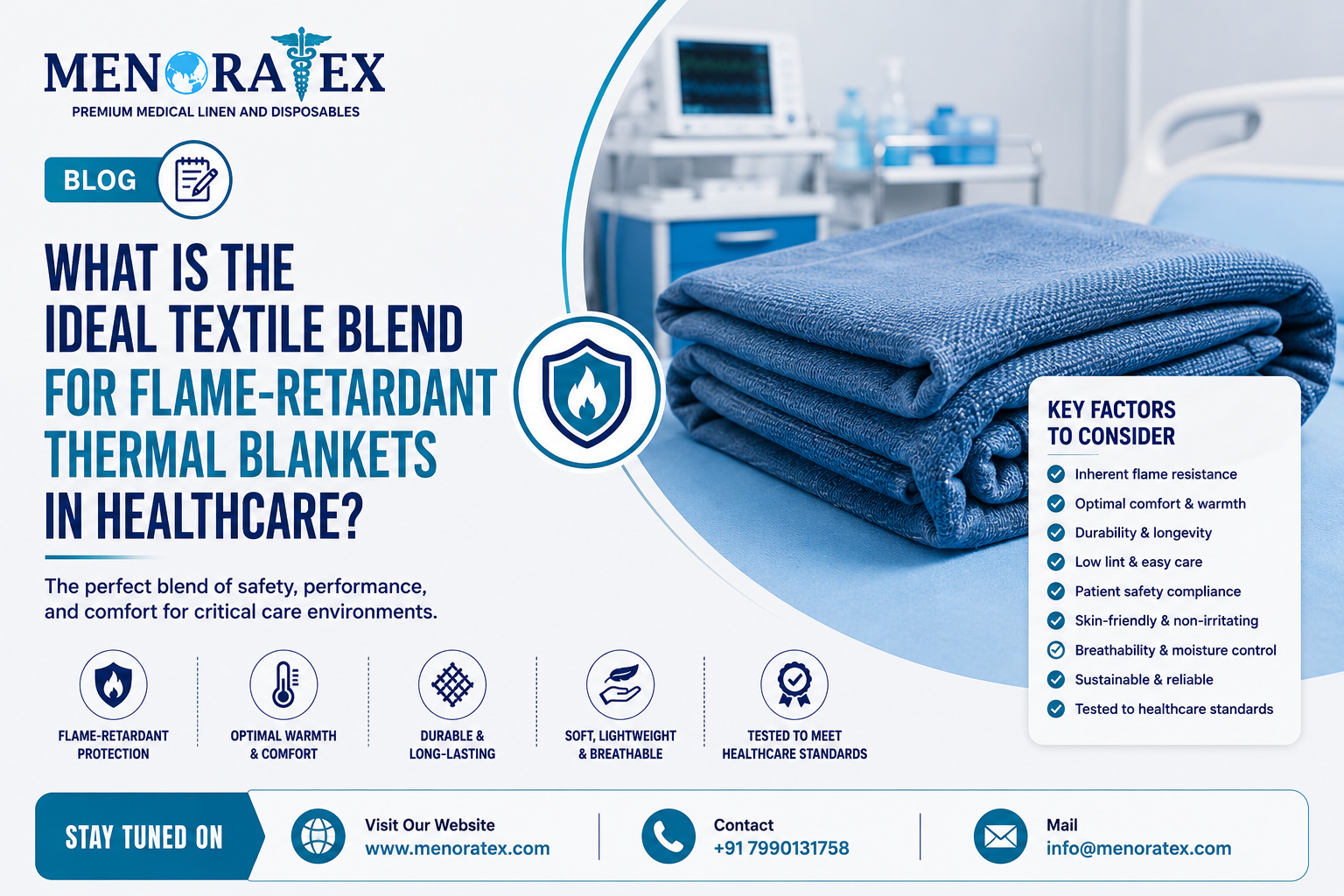
When you’re comparing suppliers or product lines, run through this checklist:
- Fiber composition disclosed clearly (e.g., 60% modacrylic / 40% cotton) — vague terms like “poly blend” aren’t enough
- Inherent flame resistance stated explicitly, or clear documentation of the topical treatment used
- GSM (grams per square meter) appropriate for thermal retention — typically 200–300 GSM for hospital thermal blankets, balancing warmth with breathability
- Colorfastness and pilling resistance after repeated industrial laundering
- Compliance documentation referencing recognized standards, not generic claims
- Hem and stitching durability — a well-made blanket resists fraying, which also affects flame behavior at seams
Step-by-Step: How to Evaluate and Select FR Thermal Blankets for Your Facility
- Define the use case first. Operating room warming blankets, ICU bedding, and general ward blankets don’t need identical specifications — match blend type to risk level.
- Request fiber composition and FR method in writing. Ask specifically whether flame resistance is inherent or applied.
- Ask for third-party test reports. Reports referencing NFPA 701 or ASTM D6413 carry more weight than a supplier’s internal claim.
- Order a sample batch and test your own laundering cycle. Run it through your facility’s actual industrial wash protocol and check for shrinkage, pilling, and any visible fabric breakdown.
- Confirm GSM and thermal performance matches what your clinical team needs for patient warming versus general bedding.
- Review supplier documentation for batch traceability. You want to be able to trace any delivered lot back to its test certificate.
- Set a re-verification schedule. If you’re using a topically treated fabric, agree on a testing interval (annually is common) to confirm FR performance hasn’t degraded.
- Train linen and laundry staff on any special handling requirements — bleach concentration limits, wash temperature, and drying cycles that could affect FR treatments.
Common Mistakes Facilities Make When Sourcing FR Bedding
- Assuming all polyester blends are automatically flame-retardant. Ordinary polyester actually melts and can drip when burning, which is dangerous near skin — it needs specific FR treatment or fiber chemistry to be safe.
- Not asking whether FR protection is inherent or topical. This single question changes your entire long-term compliance strategy.
- Over-bleaching during laundering. Aggressive bleach use can strip topical FR finishes faster than expected, quietly reducing protection without any visible change to the fabric.
- Buying on price alone. A cheaper blanket that fails an FR re-test costs far more once you factor in replacement, potential citation, and liability exposure.
- Skipping documentation review at intake. Facilities sometimes accept shipments without matching lot numbers to certificates, which creates a compliance gap that’s invisible until it’s audited.
- Ignoring seam and trim materials. A flame-retardant body fabric paired with a non-FR binding or trim can still create an ignition point.
Best Practices for Long-Term Compliance and Maintenance
- Centralize your FR documentation. Keep test certificates, lot numbers, and supplier declarations in one accessible file — digital or physical — for quick retrieval during surveys.
- Standardize your laundry protocol across in-house and outsourced laundry services, since inconsistent washing is one of the top causes of premature FR degradation.
- Rotate stock using FIFO (first in, first out) so older blankets are used and retired before newer, potentially better-performing stock.
- Retire blankets showing wear — thinning, excessive pilling, or seam damage can all affect flame behavior even if the base fiber is still technically compliant.
- Re-test periodically, especially for topically treated fabrics, rather than assuming initial certification lasts indefinitely.
- Build FR compliance into your vendor contract, not just your purchase order — this gives you contractual leverage if a batch fails to meet spec.
Cost Considerations
Flame-retardant thermal blankets typically cost more than standard bedding, and it’s worth understanding why before comparing quotes on price alone.
| Factor | Typical Range (USD) | Notes |
| Standard cotton blanket (non-FR) | $8–$15 per unit | Not appropriate for OR/ICU use |
| FR-treated poly-cotton blanket | $15–$25 per unit | Budget-friendly compliant option |
| Modacrylic-cotton inherent FR blanket | $25–$45 per unit | Premium, longest-lasting FR performance |
| Third-party FR lab testing (per fabric lot) | $300–$1,200 | Varies by standard tested and lab |
| Bulk order discounts | 10–25% off per-unit cost | Common at 500+ unit order volumes |
Facilities managing large linen inventories often find that inherently FR blends have a lower total cost of ownership, even at a higher upfront price, because they don’t need replacement as frequently and reduce the risk of a costly compliance failure.
Maintenance and Long-Term Recommendations
- Launder according to the manufacturer’s specified temperature and detergent guidelines — over-hot water or harsh detergents can shorten the useful life of FR treatments.
- Avoid fabric softeners on FR textiles unless explicitly approved by the manufacturer, since some softeners can leave residues that affect flame behavior.
- Inspect blankets during each laundry cycle for visible wear, and pull damaged units from circulation immediately.
- Maintain a replacement cycle based on wash-count estimates provided by your supplier, not just visual condition.
- Keep a small reserve of certified FR blankets separate from general stock for high-risk areas like the OR and burn unit.
Frequently Asked Questions
What makes a thermal blanket “flame-retardant” versus just “flame-resistant”?
Flame-retardant usually refers to a treatment or fiber chemistry that slows ignition and flame spread, while flame-resistant often describes a fabric that is inherently non-flammable by its chemical structure. In practice, the terms are used somewhat interchangeably in healthcare procurement, so always ask for the specific test standard rather than relying on the label alone.
Is cotton ever appropriate for hospital thermal blankets?
Pure, untreated cotton is not recommended for high fire-risk areas like operating rooms because it burns readily. Cotton blended with an inherently FR fiber like modacrylic, or cotton treated with a durable FR finish, is the safer approach.
How often should flame-retardant blankets be re-tested for compliance?
Many facilities re-test topically treated fabrics annually, while inherently FR fiber blends generally don’t require the same frequency since the protection is built into the fiber itself. Your own protocol should reflect your accrediting body’s expectations and your laundering intensity.
Do flame-retardant blankets feel different from regular hospital blankets?
Quality modacrylic-cotton blends feel very close to standard cotton bedding in softness and warmth. Some FR-treated fabrics can feel slightly stiffer initially, though this often softens somewhat after the first several wash cycles.
What’s the difference between NFPA 701 and ASTM D6413?
NFPA 701 is widely used for testing flame propagation in textiles, films, and furnishings broadly, while ASTM D6413 is a vertical flame test method often applied to flame-resistant fabrics more specifically, measuring char length and afterflame time. Some facilities request both depending on the product category.
Can I use the same FR blanket standard for both patient bedding and operating room use?
Not necessarily. Operating rooms carry higher ignition risk due to oxygen and electrosurgical equipment, so many facilities specify higher-performing inherent FR blends for the OR while allowing FR-treated blends for general ward bedding.
Does industrial laundering affect flame-retardant performance over time?
Yes, particularly for topically treated fabrics, where high heat, bleach, and repeated wash cycles can gradually reduce FR effectiveness. Inherently FR fibers like modacrylic are much more resistant to this kind of degradation.
Are flame-retardant blankets required by law in every healthcare facility?
Requirements vary by jurisdiction, facility type, and accreditation body, but most hospitals and surgical centers are expected to meet recognized flammability benchmarks as part of general fire and life safety compliance. It’s best to confirm specific requirements with your local fire marshal and accrediting organization.
What GSM is ideal for a hospital thermal blanket?
Most facilities land in the 200–300 GSM range, which balances warmth retention with breathability and manageable laundering weight. Heavier isn’t always better — overly dense fabric can trap heat unevenly or become harder to launder efficiently at scale.
How do I verify a supplier’s flame-retardant claims before placing a bulk order?
Request written fiber composition, ask whether the FR protection is inherent or topical, and require third-party test reports referencing a named standard such as NFPA 701 or ASTM D6413. Ordering a small sample batch to test in your own laundry cycle before a full order is also strongly recommended.
Conclusion
Choosing the right textile blend for flame-retardant thermal blankets isn’t just a procurement decision — it’s a patient safety decision. Modacrylic-cotton blends remain the industry benchmark for inherent, long-lasting protection, while FR-treated poly-cotton options offer a more budget-conscious path for lower-risk areas. What matters most is knowing exactly what you’re buying: the fiber composition, the FR method, and the test documentation behind it.
Facilities that treat flame-retardant bedding as a genuine compliance category — not just a checkbox — end up with lower risk, smoother accreditation surveys, and linens that actually perform when it matters.
Contact Us
Looking for a reliable source of flame-retardant thermal blankets and other hospital-grade linens for your facility? Menoratex supplies medical linens and disposables — including hospital bed sheets, pillow covers, and blankets — built for the demands of modern healthcare settings.
- Email: info@menoratex.com
- Alternate contact: kunalsharma888@gmail.com
- Phone: +91 7990131758
- Address: 310, Binori B Square 2, Opposite Hathi Singh ni Vadi, Iscon Ambli Road, Ahmedabad 380054, Gujarat, India
- Request a quote: menoratex.com/contactus