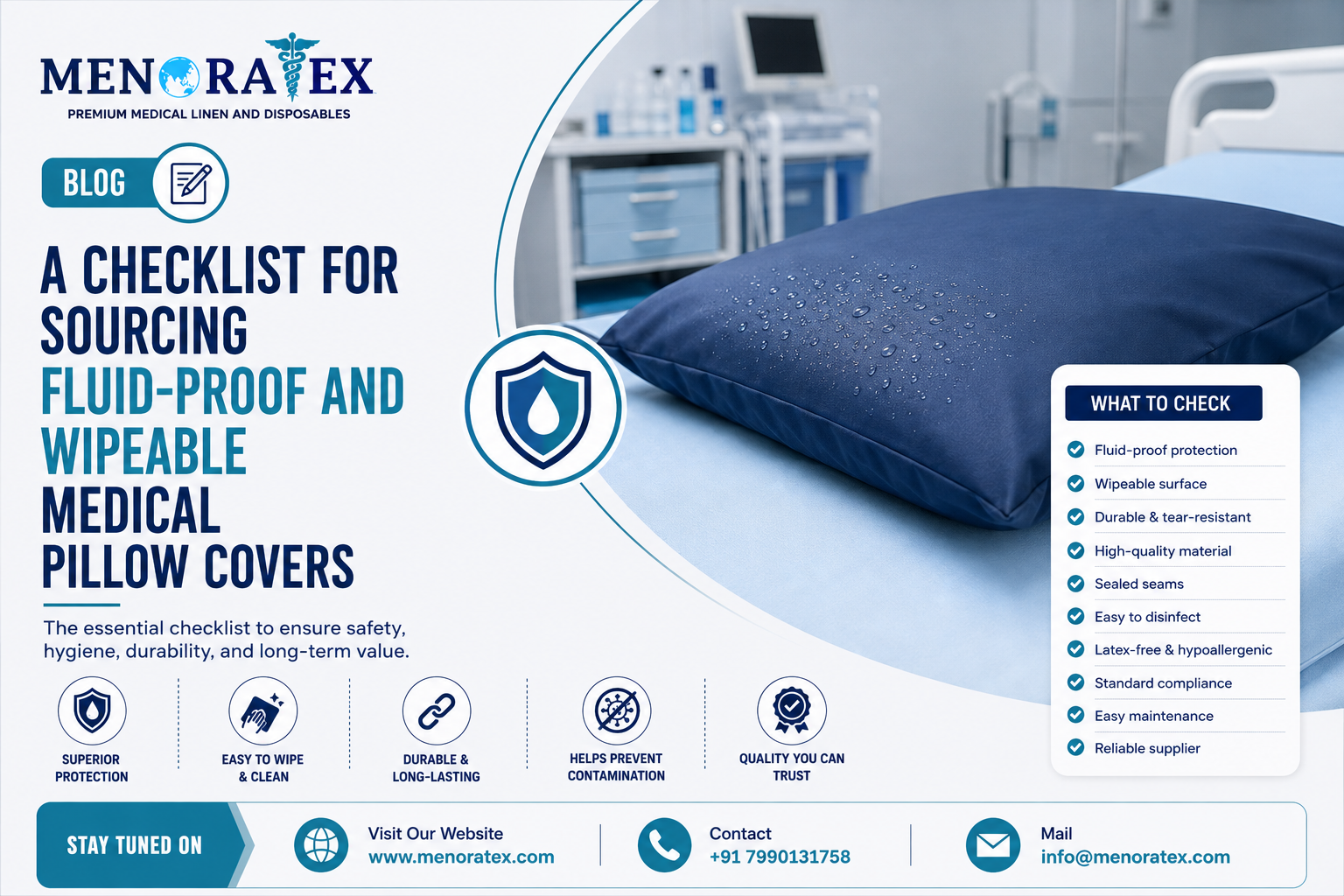
Every facility manager has had this moment: a pillow cover fails mid-shift, fluid soaks into the foam underneath, and the pillow has to be pulled from rotation for the day. Multiply that by a 120-bed hospital or a busy outpatient surgery center, and it stops being a minor inconvenience — it becomes a line item, an infection-control risk, and a scheduling headache.
Wipeable medical pillow covers exist to solve exactly this problem. But not all “waterproof” covers are created equal, and the wrong purchase decision can cost a facility far more than the sticker price suggests. This guide walks through what actually matters when sourcing wipeable hospital pillow covers in bulk — from material science to seam construction to supplier vetting — so you can buy with confidence instead of guesswork.
Whether you’re outfitting a new clinic, restocking a long-term care facility, or comparing vendors for a hospital-wide contract, this checklist is built to help you ask the right questions before you sign a purchase order.
Why Fluid-Proof Pillow Covers Matter More Than Most Buyers Realize
Pillows sit closer to a patient’s face, mouth, and respiratory zone than almost any other piece of bedding. That proximity means contamination — from saliva, wound drainage, incontinence episodes, or routine spills — reaches the pillow surface constantly, especially in acute care, long-term care, and same-day surgery settings.
A standard cotton or poly-cotton pillowcase absorbs fluid rather than blocking it. Once fluid penetrates the fabric, it reaches the foam or fiber fill inside, where it can’t be effectively cleaned. At that point, the pillow itself often has to be discarded, not just laundered.
A properly specified wipeable cover changes that equation entirely:
- Fluids bead up and stay on the surface instead of soaking through
- Staff can disinfect the cover in seconds with a standard hospital wipe
- The pillow underneath is protected from bacterial and viral contamination
- Facilities avoid premature pillow replacement, which adds up quickly across hundreds of beds
Infection prevention teams increasingly treat pillow covers the same way they treat mattress covers — as a barrier layer, not just a comfort layer. That shift in thinking is why demand for fluid-resistant and fluid-proof covers has grown steadily across hospitals, ambulatory surgery centers, dental clinics, physical therapy practices, and even veterinary facilities.
Fluid-Resistant vs. Fluid-Proof vs. Waterproof: Know the Difference
This is where a lot of buyers get tripped up, and it’s worth pausing on before you look at a single product spec sheet.
| Term What It Actually Means Best Use Case | ||
|---|---|---|
| Fluid-resistant | Repels light splashes and moisture for a limited time; may allow slow penetration under pressure or prolonged contact | Low-risk areas, general patient rooms |
| Fluid-proof | Blocks fluid penetration completely, even under sustained contact or pressure, per ASTM F1670/F1671 testing | Isolation rooms, ICU, surgical recovery |
| Waterproof | A general marketing term with no standardized medical testing behind it | Use with caution; ask for actual test data |
| Antimicrobial | Inhibits microbial growth on the surface; does not equal fluid protection on its own | Should be paired with, not substitute for, a fluid barrier |
Featured snippet answer: Fluid-proof pillow covers are tested to completely block liquid and viral penetration under pressure, typically verified through ASTM F1670 (synthetic blood) and ASTM F1671 (bloodborne pathogen) testing. Fluid-resistant covers only slow penetration and are not rated for sustained exposure.
If a supplier can’t tell you which ASTM standard their product was tested against, that’s a red flag worth noting before you move further down this checklist.
The Complete Sourcing Checklist
Use this as a working document when you’re comparing quotes from multiple suppliers. Each section below expands on why it matters.
1. Fabric and Coating Type
The base fabric and its coating determine everything else — durability, comfort, breathability, and cost.
Common constructions used in commercial healthcare bedding:
- Polyurethane (PU) laminated knit — Soft-handed, quiet (no plastic “crinkle” sound), breathable enough for extended patient comfort, and the most common choice for general ward and clinic use.
- Vinyl (PVC) coated fabric — More rigid, highly fluid-proof, and typically the least expensive option, but noisier and less breathable, which can affect patient comfort over long stays.
- TPU (thermoplastic polyurethane) film laminate — Premium option offering strong stretch recovery, excellent seam bonding, and better long-term durability against repeated disinfectant wiping.
Expert tip: For patient-facing units where comfort and noise matter — recovery rooms, long-term care, pediatric units — PU or TPU laminates are almost always worth the modest price premium over vinyl.
2. Fluid Barrier Performance (Testing and Certification)
Ask every supplier for documented test results, not just marketing claims. At minimum, request:
- ASTM F1670 — Resistance to penetration by synthetic blood
- ASTM F1671 — Resistance to penetration by bloodborne pathogens (using a bacteriophage as a viral surrogate)
- Hydrostatic head rating (measured in mmH₂O or PSI) if available, which quantifies how much water pressure the fabric withstands before leaking
A cover that only cites “waterproof” on its packaging without referencing a testing standard hasn’t necessarily been validated for clinical use.
3. Seam Construction
This is the single most overlooked failure point in wipeable covers. The fabric itself might be completely fluid-proof, but a poorly constructed seam creates a direct pathway for fluid to reach the foam.
Seam types, ranked by protection level:
- RF (radio frequency) welded seams — Heat-fused without stitching, creating a fully sealed, needle-hole-free barrier. This is the gold standard for fluid-proof performance.
- Sewn and taped seams — Stitched, then covered with a waterproof tape over the needle holes. Reliable when done correctly, but the tape can degrade with heavy laundering or aggressive disinfectant use.
- Sewn seams only (no tape) — Needle holes remain exposed, creating dozens of micro-entry points for fluid. Not appropriate for true fluid-proof claims, even if the base fabric is rated well.
If a product listing doesn’t specify seam construction, ask directly. This one detail often separates a genuinely fluid-proof cover from one that merely looks the part.
4. Closure System
The opening where the pillow is inserted is another common weak spot.
- Zippered closures with a fabric flap or storm flap covering the zipper teeth offer the best combined protection and convenience.
- Exposed zippers without a flap allow fluid to track along the zipper line and inside.
- Hook-and-loop (Velcro-style) closures are less common for pillow covers but can work well for lower-risk, non-clinical settings; they’re generally not preferred for high-acuity units due to lint and debris buildup over time.
5. Disinfectant Compatibility
This is a step buyers skip surprisingly often, and it can quietly shorten the usable life of an entire bulk order.
Hospitals typically rotate through several EPA-registered disinfectants — quaternary ammonium compounds, bleach-based solutions, hydrogen peroxide wipes, and alcohol-based products depending on the pathogen risk. Not every fabric coating tolerates every chemical class equally well.
- PU and TPU laminates generally hold up well against quats and hydrogen peroxide but can degrade faster under repeated bleach exposure.
- Vinyl tends to tolerate bleach reasonably well but can stiffen, crack, or yellow over time with heavy chemical rotation.
Ask your supplier which disinfectant classes their product has been tested against, and cross-reference that against your facility’s environmental services protocol before placing a bulk order.
6. Size and Fit Accuracy
It sounds basic, but inconsistent sizing across a bulk shipment is a common complaint. Standard sizes to confirm:
- Standard: 20 in x 26 in
- Queen: 20 in x 30 in
- King: 20 in x 36 in
- Bolster and specialty sizes for positioning cushions or wedge pillows
Request a spec sheet with tolerance ranges (e.g., +/- 0.5 in), especially for facilities that use fitted pillow shams or covers over the wipeable liner, where an oversized or undersized fit creates wrinkling and reduces the barrier’s effectiveness at the seams.
7. Color-Coding and Visual Identification
Many facilities use color-coded bedding to separate departments, risk levels, or laundering streams (even for wipeable covers that are disinfected rather than laundered). If your facility follows a color system, confirm the supplier can match it consistently across production runs — dye lot variation is common with overseas manufacturing and worth asking about upfront.
8. Compliance and Regulatory Documentation
For bulk healthcare purchasing, documentation is often just as important as the product itself, particularly for hospital procurement departments and group purchasing organizations (GPOs).
Request, where applicable:
- Material Safety Data Sheets (SDS) for the fabric and coating
- Certificates of Conformance for each production batch
- Flammability compliance where relevant (e.g., California Technical Bulletin 117 for foam-adjacent products, or applicable federal flammability standards for institutional textiles)
- Latex-free certification, since latex sensitivity is a documented concern in healthcare environments
- Country-of-origin documentation for customs and internal procurement audit purposes
9. Minimum Order Quantities and Lead Times
Bulk pricing tiers vary significantly by supplier. Before comparing quotes side by side, confirm:
- MOQ per size and color
- Production lead time versus stock availability
- Whether pricing is FOB origin or landed cost (which affects your true per-unit comparison)
- Reorder lead time for future restocking, especially important for facilities that don’t want to over-order upfront just to avoid future shortages
10. Sample Evaluation Before Committing
No spec sheet fully substitutes for a hands-on trial. Request samples and run them through your actual environment for at least one to two weeks before finalizing a bulk order.
Step-by-Step: How to Run a Proper Sample Evaluation
- Request 3–5 samples from your shortlisted suppliers, ideally in the exact size and closure type you intend to order.
- Assign them to a real unit — not a storage closet test, but active use in patient rooms or exam areas for at least 10–14 days.
- Test with your actual disinfectant rotation, not just water, since chemical compatibility is where many covers fail first.
- Check seams and zipper areas after repeated wiping for any sign of delamination, cracking, or fluid seepage.
- Get feedback from frontline staff on comfort, noise, and ease of cleaning — their input often catches issues a spec sheet never would.
- Document wear after the trial period with photos and notes before making a final purchasing decision.
Common Mistakes When Sourcing Bulk Pillow Covers
- Trusting the word “waterproof” without asking for test data. As covered above, it’s not a regulated or standardized term on its own.
- Ignoring seam construction entirely. A high-quality fabric with weak seams still fails in real-world use.
- Choosing the lowest price per unit without factoring in replacement frequency. A cheaper cover that needs replacing twice as often isn’t actually saving money.
- Skipping the sample trial to save time. This almost always costs more time later when a bulk order underperforms.
- Not confirming disinfectant compatibility with environmental services. A mismatch here shortens product life dramatically.
- Overlooking country-of-origin and compliance paperwork, which can create delays during procurement audits or customs clearance.
- Assuming all “medical grade” claims are equivalent. Ask what specific standard is being referenced every time you see that phrase.
Best Practices for Long-Term Sourcing Success
- Build a two-supplier strategy. Relying on a single source creates risk if there’s a production delay, quality issue, or shipping disruption. Many procurement teams keep a primary and a backup vendor qualified simultaneously.
- Standardize sizing and closure type across departments where possible, to simplify inventory management and reduce staff confusion during restocking.
- Set a replacement cycle, typically every 12–24 months depending on usage intensity, rather than waiting for visible failure.
- Keep a maintenance log per unit noting date of installation, disinfectant rotation used, and any early signs of wear.
- Revisit your specification annually. Fabric technology and disinfectant formulations both evolve, and a spec that was ideal two years ago may not be the best option today.
Maintenance and Cleaning Recommendations
Even fluid-proof covers need proper care to reach their full service life:
- Wipe down with facility-approved disinfectant after each patient use, following the product’s recommended dwell time (the time the disinfectant needs to remain wet on the surface to be effective).
- Avoid abrasive scrubbing pads, which can accelerate coating wear at the seams first.
- Inspect zippers and seams weekly in high-turnover units, and monthly in lower-turnover settings.
- Rotate stock so covers aren’t in constant use without a rest period, which extends coating life.
- Retire and replace any cover showing cracking, peeling, or discoloration immediately — a compromised barrier is worse than no barrier, since staff may assume protection that no longer exists.
Cost Considerations
Pricing varies by fabric type, seam construction, and order volume, but as a general guide for bulk procurement:
| Cover Type Typical Bulk Price Range (per unit, USD) Expected Lifespan | ||
|---|---|---|
| Vinyl, sewn seam | $2.50 – $4.50 | 8–14 months |
| Vinyl, welded seam | $3.50 – $6.00 | 12–18 months |
| PU laminate, sewn and taped | $4.50 – $7.50 | 14–20 months |
| TPU laminate, welded seam | $6.50 – $10.00 | 18–30 months |
Prices fluctuate with raw material costs, order size, and destination shipping, so treat this table as a planning benchmark rather than a fixed quote. When comparing suppliers, always calculate cost per month of service life, not just cost per unit — a $4 cover that lasts 20 months is often cheaper in practice than a $2.50 cover that lasts 8.
Frequently Asked Questions
What is the difference between fluid-resistant and fluid-proof pillow covers? Fluid-resistant covers slow down moisture penetration for a limited time, while fluid-proof covers, typically tested to ASTM F1670/F1671, completely block fluid and viral penetration even under sustained pressure or contact.
Are wipeable pillow covers the same as waterproof mattress covers? They serve the same protective purpose but are sized and shaped differently. Both should ideally use similar fabric technology and seam construction standards for consistent infection-control performance.
How often should hospital pillow covers be replaced? Most facilities replace wipeable pillow covers every 12 to 24 months depending on usage intensity, disinfectant rotation, and visible signs of wear such as cracking or seam separation.
Can wipeable pillow covers be laundered as well as wiped down? Many PU and TPU laminate covers can tolerate limited machine washing on gentle cycles, but repeated laundering typically shortens their service life faster than wiping alone. Always follow the manufacturer’s specific care instructions.
What size are standard hospital pillow covers? Standard hospital pillow covers are typically 20 inches by 26 inches, with queen (20 x 30 in) and king (20 x 36 in) sizes also common depending on the pillow used.
Do wipeable pillow covers contain latex? Reputable medical suppliers offer latex-free options as standard, given documented latex sensitivity concerns in healthcare settings. Always confirm latex-free certification in writing before ordering in bulk.
What disinfectants are safe to use on wipeable pillow covers? Compatibility depends on the fabric coating. PU and TPU laminates generally tolerate quaternary ammonium compounds and hydrogen peroxide wipes well, while vinyl handles bleach-based products reasonably well but may stiffen over time with heavy use.
Is a welded seam really better than a sewn seam? Yes, in most cases. Radio-frequency welded seams eliminate needle holes entirely, creating a continuous fluid barrier, while sewn seams — even when taped — carry a slightly higher long-term risk of fluid tracking through stitch lines.
What questions should I ask a supplier before placing a bulk order? Ask about ASTM testing documentation, seam construction type, disinfectant compatibility, minimum order quantities, lead times, and whether samples are available for a trial period before committing to a full order.
How do I calculate the true cost of bulk pillow covers? Divide the per-unit price by the expected service life in months to get a cost-per-month figure, then compare that number across suppliers rather than comparing sticker price alone.
Conclusion
Sourcing wipeable, fluid-proof pillow covers isn’t just a procurement task — it’s an infection-control decision with real downstream effects on patient safety, staff workload, and facility budgets. The details that seem small on a spec sheet, like seam construction and disinfectant compatibility, are usually the details that determine whether a bulk order performs well for two years or fails within eight months.
Use the checklist above every time you evaluate a new supplier or renew an existing contract, and don’t skip the sample trial stage no matter how tight your timeline feels. It’s the single best way to catch a problem before it shows up across an entire hospital wing.
Ready to Source Reliable, Fluid-Proof Pillow Covers in Bulk?
If you’re comparing suppliers for wipeable hospital pillow covers, Menoratex manufactures and exports medical-grade bedding and disposables built for real clinical use, with documentation to match.
Contact Us
Email: info\@menoratex.com
Phone: +91 7990131758