Introduction
A single failed linen delivery can shut down an operating room schedule for hours. A batch of bed sheets that pills after ten washes turns into a mountain of complaint tickets from nursing staff. A glove shipment that doesn’t quite meet ASTM barrier standards can expose a facility to liability nobody wants to think about.
Most procurement directors don’t find out about these problems from a lab report. They find out from a nurse manager’s angry email, or worse, from an infection control incident.
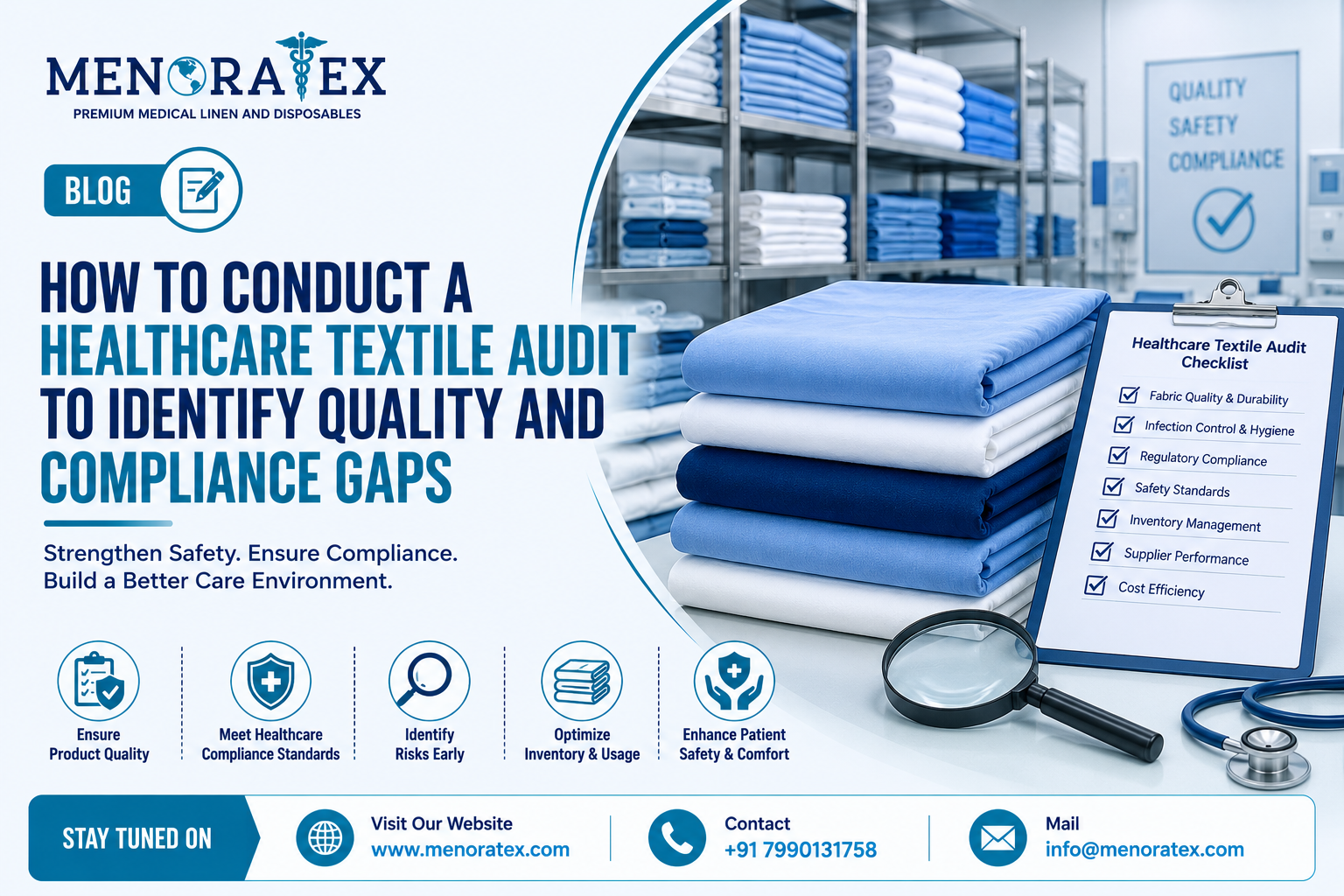
A healthcare textile audit is how you get ahead of that. It’s a structured way to check whether the linens, gowns, drapes, and disposables coming into your facility actually meet the quality and compliance standards your contracts promise. Done well, it protects patients, protects your budget, and gives you leverage the next time a supplier renegotiation comes around.
This guide walks through exactly how to run one, what to look for, and how to turn the findings into real supplier accountability.
Why a Healthcare Textile Audit Matters
Healthcare textiles aren’t just fabric. They’re part of the infection control chain, the patient comfort experience, and the facility’s regulatory exposure all at once. A weak link anywhere in that chain creates risk that’s easy to overlook until it becomes expensive.
The Real Cost of Skipping It
Facilities that never formally audit their textile suppliers tend to discover problems reactively:
- Linens that shrink out of size tolerance after a handful of industrial washes
- Surgical gowns with inconsistent fluid-barrier ratings across the same lot
- Gloves that fail tactile sensitivity or tensile strength checks
- Delivery shortfalls that force last-minute rentals at premium prices
- Documentation gaps that surface only during a Joint Commission survey
Each of these is a quality or compliance gap that a routine audit would have caught months earlier, while there was still time to fix it without disrupting patient care.
Who Should Care About This
- Procurement directors and supply chain managers evaluating current vendors or vetting new ones
- Materials management teams at hospitals, ambulatory surgery centers (ASCs), and long-term care facilities
- Infection prevention and environmental services leaders who depend on textile performance for their protocols
- Facility administrators accountable for regulatory readiness
If your role touches linen contracts, glove purchasing, or surgical textile sourcing, this process applies directly to you.
What Counts as a “Healthcare Textile”
Before auditing, it helps to define scope. Healthcare textiles typically fall into three categories:
| Category | Examples |
|---|---|
| Reusable linens | Bed sheets, pillowcases, blankets, patient gowns, privacy curtains |
| Reusable protective textiles | Surgical drapes, scrub attire, isolation gowns |
| Single-use disposables | Exam gloves, face masks, shoe covers, surgical caps, disposable gowns |
A full audit ideally covers all three, since a facility’s infection control posture depends on how they work together, not on any one category in isolation.
Benefits of a Regular Textile Audit Program
Running audits on a set schedule, rather than only after something goes wrong, pays off in several ways.
- Fewer clinical disruptions. Catching a GSM (grams per square meter) inconsistency in towels before it affects absorbency on the floor prevents nursing complaints and workflow slowdowns.
- Stronger negotiating position. Documented performance data gives you leverage at contract renewal, whether you’re asking for pricing concessions or threatening to switch suppliers.
- Lower liability exposure. Verified barrier performance on gowns and gloves supports your facility’s defense if a claim ever questions PPE adequacy.
- Better budget forecasting. Audits reveal true linen loss and replacement rates, which sharpens your reorder planning instead of relying on guesswork.
- Survey readiness. Regulatory surveyors increasingly ask for supplier quality documentation, not just onsite observations.
Core Features of a Strong Audit Framework
A textile audit isn’t a single inspection. It’s a framework with a few consistent components:
- A defined scope — which product categories, which facilities, which time period
- Objective specifications — the exact standards each product must meet (GSM, thread count, tensile strength, barrier level)
- A sampling method — how many units get pulled and from where in the supply chain
- A scoring system — a way to rate findings so results are comparable audit over audit
- A corrective action process — what happens after gaps are found
Without these five elements, an audit becomes a one-off spot check rather than a repeatable quality system.
Step-by-Step Guide: How to Conduct a Healthcare Textile Audit
Step 1: Define the Audit Scope and Objectives
Start by deciding what you’re actually testing for. Are you auditing a single product line, like exam gloves, or your entire linen program? Are you responding to a specific complaint pattern, or running a scheduled quarterly review?
Write this down. A vague scope produces a vague report that’s hard to act on.
Practical tip: Tie the scope to your contract’s specification sheet. If your supplier agreement references a specific GSM range or ASTM standard, that becomes your audit baseline automatically.
Step 2: Gather Supplier Documentation
Before physically inspecting anything, request the paperwork that should already exist:
- Certificates of conformance for the current lot
- Third-party lab test reports (barrier performance, tensile strength, colorfastness)
- Country-of-origin and material composition statements
- Relevant certifications (ISO 13485 for medical devices where applicable, OEKO-TEX for textile safety, ASTM ratings for gloves and gowns)
- Chain-of-custody or traceability records for the batch
A supplier that can’t produce current documentation on request is itself a compliance gap, regardless of what the physical product looks like.
Step 3: Pull a Representative Sample
Random spot-checking a handful of units from the top of one box tells you almost nothing about lot consistency. Instead:
- Sample from multiple cartons within the same shipment, not just one
- Include units from both the beginning and end of a production run when lot numbers allow it
- For reusable linens, pull items that have already been through several laundering cycles, not just brand-new stock
- Aim for a sample size proportional to shipment volume (a common rule of thumb is inspecting at least 2% of units per lot, with a higher percentage for critical items like surgical gowns)
Step 4: Conduct Physical Quality Inspection
This is where you evaluate the product against your written specifications. Depending on the textile type, checks typically include:
For linens and reusable fabrics:
- GSM verification using a fabric weight scale
- Thread count and weave consistency (percale vs. other weaves)
- Colorfastness after simulated washing
- Seam strength and stitching consistency
- Shrinkage tolerance after laundering cycles
- Presence of pilling, thinning, or fabric degradation
For gloves and single-use PPE:
- Tensile strength and elongation testing
- Pinhole/leak testing (AQL sampling per ASTM D5151 for medical gloves)
- Fit and tactile sensitivity
- Packaging integrity and expiration labeling
For surgical gowns and drapes:
- AAMI PB70 barrier level verification matching the level specified in your contract
- Seam and closure integrity
- Fluid-repellency performance
Quick tip: Keep a laminated reference card with your facility’s exact specification thresholds on hand during physical inspections. It removes ambiguity and keeps different auditors scoring consistently.
Step 5: Review Compliance Against Regulatory Standards
Cross-check the sample against the regulatory framework relevant to your facility type:
- AAMI/ANSI PB70 for liquid barrier performance classification of gowns and drapes
- ASTM standards (D6319, D5151, D3578) for gloves and related PPE
- NFPA 701 and CPSC flammability standards for thermal blankets and certain fabric items
- Joint Commission Environment of Care (EC) standards, which reference textile and PPE adequacy as part of infection control readiness
- State health department requirements, which can add facility-specific rules on top of federal baselines
Document exactly which standard each item was checked against and the outcome, not just a pass/fail note.
Step 6: Score and Categorize Findings
Convert your inspection notes into a structured scorecard. A simple three-tier system works well for most facilities:
| Severity | Definition | Example |
|---|---|---|
| Critical | Direct patient safety or compliance risk | Gown fails barrier level required for the procedure type |
| Major | Significant quality issue affecting usability | GSM consistently 15%+ below contracted spec |
| Minor | Cosmetic or low-impact deviation | Slight color variation between lots |
Scoring this way lets you compare results across quarters and across suppliers using the same scale.
Step 7: Deliver Findings and Request Corrective Action
Share the audit report with the supplier directly, not just internally. Include:
- Specific findings with photos or test data where possible
- The severity classification for each issue
- A requested timeline for corrective action
- Whether you expect a formal Corrective and Preventive Action (CAPA) response
Reputable suppliers expect this kind of feedback and should respond with a written plan, not just a verbal reassurance.
Step 8: Follow Up and Re-Audit
An audit that ends at the findings report accomplishes half the job. Schedule a follow-up inspection, typically within 60 to 90 days, focused specifically on the items flagged as Critical or Major. If the same gaps reappear, that’s a strong signal to escalate toward contract renegotiation or supplier replacement.
Common Mistakes Procurement Teams Make
- Auditing only new stock. Reusable textiles degrade with laundering cycles, so testing only fresh-off-the-truck items misses the real-world performance curve.
- Relying entirely on supplier-provided lab reports. Third-party verification, even on a spot-check basis, catches issues self-reported data won’t.
- Treating audits as one-time events. Quality can drift between shipments even from a consistent supplier. A single clean audit doesn’t guarantee the next lot performs the same way.
- Skipping documentation review. Physical inspection without checking certifications and traceability leaves a compliance blind spot, especially for imported textiles and disposables.
- Not involving frontline staff. Nursing and environmental services teams notice performance issues procurement never sees directly. Their input should feed into what gets audited.
- No standardized scoring. Without a consistent scorecard, it’s nearly impossible to prove a pattern of decline to a supplier during renegotiation.
Best Practices for a Reliable Audit Program
- Set a fixed audit cadence. Quarterly works well for high-volume categories like gloves and linens; semi-annual may be sufficient for lower-turnover items.
- Rotate who conducts inspections. A second set of eyes periodically reduces the chance of consistent blind spots in your process.
- Keep specification sheets current. Update your audit checklist whenever contract terms change, so you’re never scoring against an outdated benchmark.
- Build a supplier scorecard history. Track results over multiple audit cycles per supplier so trends, not single incidents, drive sourcing decisions.
- Loop in infection prevention early. Their clinical perspective on barrier performance and contamination risk adds credibility to your findings.
- Use third-party labs for critical categories. For high-risk items like surgical gowns and exam gloves, independent verification carries more weight in supplier negotiations than in-house testing alone.
Expert Tips
“The suppliers who push back hardest on audit requests are usually the ones with the most to hide. A confident, well-run supplier welcomes scrutiny because their documentation already backs them up.”
- Request a supplier’s own internal quality control process documentation, not just finished-product test results. It tells you whether quality is built in or inspected in after the fact.
- Ask new suppliers for a sample audit report from an existing client relationship (with permission) before finalizing a contract. It’s a strong predictor of what your own experience will look like.
- Don’t audit in isolation from your linen loss tracking. A pattern of high replacement rates often correlates directly with underlying quality gaps an audit will confirm.
Cost Considerations
Running an internal audit program has real costs, but they’re modest compared to the cost of a compliance failure or a widespread quality issue reaching patient care areas.
- Internal labor time: Budget for roughly 4–8 staff hours per quarterly audit cycle for a mid-sized facility, depending on scope.
- Fabric weight scales and basic testing tools: A reliable GSM scale and tensile tester for in-house checks typically runs $300–$1,500 depending on precision needs.
- Third-party lab verification: Independent testing for critical items like surgical gowns or gloves generally costs $150–$500 per sample batch, depending on the standard being verified.
- Cost of inaction: A single linen shortage forcing emergency rental can cost several times the annual price of a proper audit program, not counting the operational disruption.
Most facilities find that a structured audit program pays for itself within the first year through reduced waste, fewer emergency purchases, and stronger negotiating leverage at contract renewal.
Long-Term Recommendations
- Build textile audit results into your annual supplier review, alongside pricing and delivery performance.
- Maintain a rolling three-year history of audit scores per supplier to spot slow degradation that a single audit cycle might miss.
- Revisit your specification sheet annually against current ASTM, AAMI, and Joint Commission updates, since standards are periodically revised.
- Treat consistently high-performing suppliers as strategic partners, not just vendors, and involve them early when your facility’s needs change.
Frequently Asked Questions
1. How often should a hospital audit its textile suppliers?
Most facilities benefit from quarterly audits for high-volume items like gloves and linens, with semi-annual reviews for lower-turnover categories such as thermal blankets.
2. What’s the difference between a textile audit and a routine quality inspection?
A routine inspection typically checks a single delivery against basic specs. A full textile audit is broader, covering documentation review, regulatory compliance, sampling across multiple lots, and a formal corrective action process.
3. Do single-use disposables need the same audit rigor as reusable linens?
Yes, arguably more. Disposables like gloves and gowns have no laundering cycle to “reset” quality issues, so a defect in one lot affects every unit in that batch equally.
4. What regulatory standards apply to healthcare textile audits?
Common references include AAMI/ANSI PB70 for barrier performance, ASTM standards for gloves and PPE, NFPA 701 and CPSC flammability rules for certain fabrics, and Joint Commission Environment of Care standards.
5. Can a facility conduct an audit without third-party lab testing?
Yes, for many quality checks like GSM, seam strength, and visual inspection. However, critical safety items such as surgical gowns and exam gloves benefit significantly from independent lab verification.
6. What should happen if a supplier fails an audit?
The supplier should receive a formal findings report with a requested corrective action timeline. Facilities typically schedule a re-audit within 60–90 days to confirm the issue was resolved before considering contract action.
7. How large should the inspection sample be?
A common guideline is inspecting at least 2% of units per shipment lot, with higher sampling rates for critical PPE categories like surgical gowns and gloves.
8. Who should be involved in a healthcare textile audit?
Procurement or materials management typically leads the process, with input from infection prevention, environmental services, and clinical staff who interact with the textiles daily.
9. What’s the biggest red flag during a supplier audit?
Inability to produce current lab test reports or certificates of conformance on request. Missing documentation is often a stronger warning sign than a single physical defect.
10. How does a textile audit help during contract negotiations?
Documented performance history gives procurement objective leverage, whether pushing for pricing adjustments, requesting corrective action, or justifying a switch to a new supplier.
Conclusion
A healthcare textile audit isn’t a bureaucratic checkbox. It’s the mechanism that catches a quality or compliance gap while it’s still a paperwork problem, not a patient safety incident. Facilities that build a consistent, documented audit cadence protect their budgets, strengthen their supplier relationships, and walk into every contract renewal with real data instead of guesswork.
The process doesn’t need to be complicated. Define your scope, check the documentation, inspect a representative sample, score what you find, and follow up until the gaps close. That’s the whole framework, applied consistently over time.
Call to Action
Looking for a healthcare textile supplier that welcomes this level of scrutiny? Menoratex supplies hospital-grade linens, surgical textiles, and medical disposables with full documentation and lab-verified quality on every shipment, ready to stand up to your next audit.
Contact Us
Email: info@menoratex.com | kunalsharma888@gmail.com
Phone: +91 7990131758
Request a quote: menoratex.com/contact-us