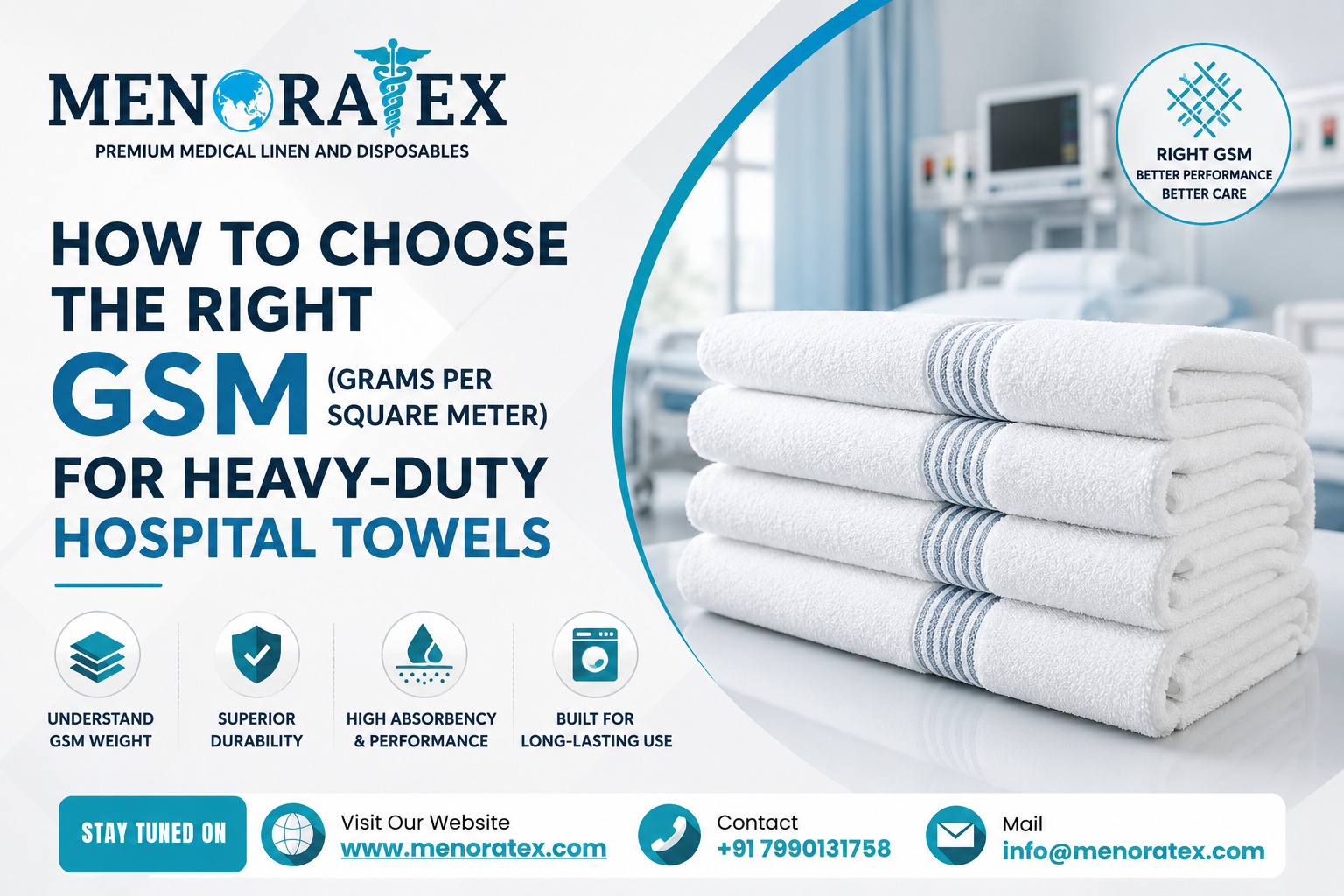
If you’ve ever placed a bulk order for hospital towels only to watch them turn thin, rough, and torn after a few dozen wash cycles, you already know the real cost of picking the wrong GSM. It isn’t just a fabric spec buried in a supplier’s spec sheet — it’s the number that decides whether your linen budget lasts a year or quietly drains away every few months.
For procurement teams and hospital administrators researching wholesale medical towel weight, GSM (grams per square meter) is one of the most misunderstood numbers in the entire RFQ. Suppliers throw it around, buyers nod along, and then the towels arrive and either fall apart in industrial laundering or feel needlessly heavy and slow to dry.
In this guide, we’ll walk through exactly what GSM means for hospital towels, how it affects absorbency and durability, which GSM range fits which use case, and the sourcing mistakes that quietly cost facilities thousands of dollars in early replacements.
What Is GSM and Why It Matters for Hospital Towels
The Simple Definition
GSM stands for grams per square meter. It measures how much a single square meter of fabric weighs. A 300 GSM towel is lighter and thinner than a 600 GSM towel of the same size. In everyday retail terms, GSM is what separates a flimsy gym towel from a plush bath towel.
Why Hospitals Can’t Treat GSM Like a Retail Spec
A retail buyer picks GSM based on softness and feel. A hospital procurement team has to think about something retail buyers never worry about: industrial laundering. Hospital towels go through high-temperature washes, strong detergents, tumble drying, and dozens of handling cycles every single week. That environment breaks down fibers far faster than a home washing machine ever would.
This is why GSM in a healthcare setting isn’t a comfort metric — it’s a durability and cost-per-use metric. Choose too low, and you’ll be reordering constantly. Choose too high, and you’ll pay more upfront while also slowing down your laundry turnaround.
How GSM Affects Absorbency, Durability, and Cost
As GSM increases, three things generally happen: the towel holds more water, it withstands more wash cycles before fraying, and it costs more per unit and takes longer to dry. The table below breaks down what each GSM band typically delivers in a hospital environment.
| GSM Range | Feel & Density | Absorbency | Durability (Wash Cycles) | Best Use Case |
|---|---|---|---|---|
| 250–350 GSM | Thin, lightweight | Low to moderate | 50–100 washes | Low-use wipes, disposable-style towels |
| 350–450 GSM | Medium weight | Moderate | 100–150 washes | General patient hygiene, staff hand towels |
| 450–550 GSM | Dense, plush | High | 150–250 washes | Patient bathing, surgical hand drying |
| 550–650 GSM | Heavy-duty | Very high | 250–350 washes | ICU, high-frequency wards, rehabilitation centers |
| 650+ GSM | Extra thick | Maximum | 350+ washes | Specialty/luxury healthcare facilities, spa-hospital hybrid units |
Industry insight: Most hospital procurement teams overlook that drying time scales with GSM too. A 650 GSM towel can take up to 40% longer to dry in industrial dryers than a 450 GSM towel — which matters if your laundry room runs on tight turnaround schedules.
Common Hospital Towel Applications and Their Ideal GSM Range
Patient Bathing Towels
These need high absorbency and a soft hand-feel since they’re in direct, repeated contact with patient skin. A GSM of 450–550 hits the sweet spot: soft enough for comfort, dense enough to survive frequent institutional washing.
Surgical Hand-Drying Towels
Speed and hygiene matter more than plushness here. Many facilities use disposable non-woven towels for this application, or lower-GSM woven towels (300–400 GSM) that dry hands quickly without excess bulk.
Housekeeping and Utility Towels
These take the most abuse — spills, cleaning chemicals, constant handling. A mid-to-heavy GSM range of 400– 500 balances durability with cost, since these towels are replaced more frequently regardless of weight.
ICU and High-Frequency Ward Towels
Wards with the highest usage frequency justify the investment in 550–650 GSM towels. The higher upfront cost is offset by a significantly longer replacement cycle, which actually lowers the total cost of ownership over a year.
Step-by-Step: How to Choose the Right GSM for Your Facility
1. Map your use cases first.
List every towel application in your facility — patient care, surgical, housekeeping, staff — before looking at a single spec sheet.
2. Check your laundering conditions.
High-temperature industrial washing and frequent tumble drying justify a higher GSM than a facility using lower-heat commercial laundering.
3. Balance GSM against wash frequency, not just wash count.
A towel washed daily needs a different GSM than one washed twice a week, even if the total lifetime wash count is similar.
4. Ask for the fiber blend, not just the GSM number.
A 500 GSM towel made from a durable cotton-polyester blend can outlast a 550 GSM 100% cotton towel under harsh laundering.
5. Request physical samples before committing to a bulk order.
Run them through your actual laundry cycle 10–15 times and inspect fraying, shrinkage, and thinning.
6. Confirm compliance certifications.
For hospitals serving the U.S. market, ask whether the manufacturer is FDA-registered and whether the facility follows ISO-compliant manufacturing standards.
7. Negotiate GSM tiers by department, not a single facility-wide spec.
Mixing 450 GSM for general wards with 600 GSM for ICU often lowers total spend versus a single blanket order.
Common Mistakes Buyers Make When Selecting Towel GSM
- Assuming higher GSM is always better — it often just means higher cost and slower drying without matching your actual usage pattern.
- Ignoring the fiber blend and judging quality by GSM number alone.
- Ordering a single GSM for the entire facility instead of matching weight to department-level usage intensity.
- Skipping a wash-cycle test before placing a large wholesale order.
- Overlooking drying time, which affects laundry room throughput and staffing costs.
- Not asking for durability data — reputable suppliers should be able to share expected wash-cycle lifespan, not just GSM.
Best Practices and Expert Tips
- Request a “wash-cycle to failure” sample test rather than relying on GSM alone — this is the real durability metric.
- For facilities with in-house industrial laundry, prioritize blended fabrics (cotton-poly) at 450–550 GSM for the best durability-to-cost ratio.
- For facilities outsourcing laundering to third-party services, ask the laundry vendor which GSM range performs best under their specific equipment and detergents.
- Build a tiered GSM strategy: lighter weight for low-contact tasks, heavier weight for high-frequency, high-contact patient care areas.
- Reinforced hems and double-stitched edges often extend towel life more than an incremental GSM increase — ask suppliers about stitching quality, not just weight.
Real-World Example
Consider a mid-sized 200-bed hospital that standardized on a single 350 GSM towel across every department to save on upfront cost. Within four months, ICU and general ward towels—the highest-frequency-use items—were showing significant fraying and thinning, forcing an early reorder that erased the initial savings.
After switching to a tiered approach—400 GSM for housekeeping, 500 GSM for general patient care, and 600 GSM for ICU—the facility’s replacement cycle nearly doubled in the highest-use areas, and total annual linen spend dropped by roughly 18%, even though the per-unit cost of the heavier towels was higher.
This is the core lesson for any technical buyer evaluating wholesale medical towel weight: GSM decisions should be made by department, not by a single facility-wide average.
Pros and Cons: High GSM vs. Low GSM Hospital Towels
| Factor | High GSM (550+) | Low GSM (Below 400) |
|---|---|---|
| Absorbency | Excellent | Fair to moderate |
| Durability under industrial washing | Very high | Lower, wears out faster |
| Upfront cost per unit | Higher | Lower |
| Drying time | Longer | Shorter |
| Weight | Heavier | Lighter |
| Laundry throughput | Lower due to longer drying | Higher due to faster drying |
| Best fit | ICU, operating rooms, high-frequency patient care wards | Housekeeping, low-contact tasks, short-term use |
| Long-term cost | Lower over time due to longer service life | Can be higher due to more frequent replacement |
Future Trends in Hospital Towel Weight Standards
Healthcare textile sourcing is shifting in a few clear directions worth watching. Sustainable cotton-blend fibers are being engineered to hit higher durability at lower GSM, reducing both fabric weight and drying energy costs. Facilities are also increasingly asking for wash-cycle warranties instead of relying on GSM as a standalone quality signal. And as hospitals scrutinize total cost of ownership more closely, expect more suppliers to offer department-specific GSM tiers as a standard catalog option rather than a custom request.
Why Buyers Choose Menoratex for GSM-Customized Hospital Towels
At Menoratex, a premium medical linen brand under Radhe Overseas, we work directly with hospitals, nursing homes, and healthcare distributors across the U.S. to specify the right GSM for every department—not a one-size-fits-all number.
- FDA-registered and CE-certified manufacturing partners
- ISO 13485-compliant production facilities
- Custom GSM tiers, fiber blends, and sizing for bulk and private-label orders
- Sample-first ordering so you can wash-test before committing to a bulk purchase
- Led by Kunal Sharma, with 15+ years of experience supplying the U.S. healthcare textile market
Conclusion: Key Takeaways
- GSM measures fabric weight, and for hospital towels it’s really a durability and cost-per-use metric, not just a comfort specification.
- Most hospitals achieve the best balance in the 450–550 GSM range, with heavier weights reserved for ICU and other high-frequency patient care areas.
- Match GSM to department usage rather than selecting a single weight for the entire facility.
- Always request a fiber-blend breakdown and a physical wash-cycle sample test before placing a bulk order.
Ready to Specify the Right GSM for Your Facility?
Menoratex can help you build a department-by-department towel weight plan with sample testing, FDA-registered sourcing, and bulk pricing designed for hospitals, nursing homes, and healthcare distributors.
To request samples or receive a wholesale quote, reach out through the Contact Us form on this page, email info@menoratex.com, or call/WhatsApp +91 7990131758.
Contact Us
Have questions about GSM, fiber blends, or bulk pricing for your facility? Fill out the Contact Us form below, and our team will get back to you with product samples and a customized wholesale quote.
Reach Us Directly
- Email: info@menoratex.com
- Phone / WhatsApp: +91 7990131758